
The Sentinel Weekly: Winging it
It’s not stupid if it works

‘Gold-plating’ refers to the defence industry’s habit of making equipment unnecessarily complex and expensive, creating delays and cost overruns for marginal increases in performance.
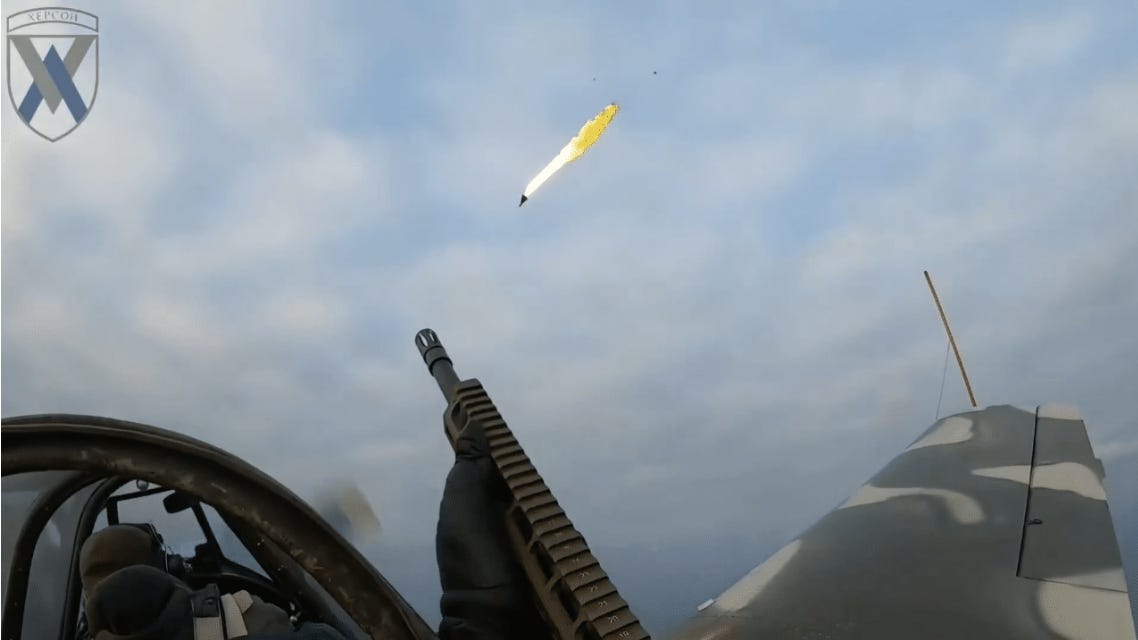
There isn’t a word for the opposite, so an image will have to do. A new video released by the Ukrainian armed forces shows an airman leaning out of the back of a Soviet-era propeller-engined training aircraft with an assault rifle, and successfully engaging a series of Russian strike drones.
It’s a dramatic illustration of the gap between peacetime military procurement and the reality of total war. While planners come up with ever more complex and costly platforms to counter their rivals’ most advanced kit, much of the real fighting happens with the systems that are available, cheap to operate and easy to maintain.
In total war, there’s no such thing as obsolete. The Yak-52 would lose a dogfight with a Spitfire, and yet Ukraine has found a combat role for it. It wouldn’t last a minute against a Russian Su-27 or a MiG-29, but the enemy’s best kit can’t be everywhere at once, especially in the fifth year of a war.
Much of Western doctrine suffers from a ‘first battle bias’ that optimises for winning early engagements. Against a much inferior opponent, it can be devastating; witness the crushing of Iraqi forces in the first Gulf War. But if an enemy can survive the initial onslaught, questions of sustainability come to the fore.
In developing the Shahed drone, Iran found a successful counter to NATO doctrine. Air defences optimised for intercepting the world’s most advanced ballistic missiles can, over time, be defeated by swarms of cheap, low-tech effectors.
Ukraine and other Western powers are now developing new weapons and tactics to counter the Shahed. Russia, in turn, is modifying its strike drones – with jet engines, greater manoeuvrability, and even air-to-air missiles – to regain the edge. And so the superfast wartime innovation cycle continues.
The right tool for the job
The problems with ‘gold-plated’ equipment go beyond expense and scarcity. Sometimes it can be so highly optimised for a specific role that it’s ill-suited for others, and in this sense too the example of the Yak-52 is instructive.
Modern fighter jets engineered to fight each other can be surprisingly poor at engaging less sophisticated targets. The requirements for high maximum speed, range and manoeuvrability come with a trade-off: They’re physically incapable of flying slowly.
The F-16 can fly at more than 2,000kph but not at less than 200kph: at some point between 200-300kph (depending on variant and loadout) the wings will stall, making controlled and level flight below that speed impossible.
That makes it ill-suited to engaging a Shahed, which typically cruises below 200kph. At that speed an F-16 can’t maintain a stable firing position, giving its pilot two bad options: expend a very expensive guided missile, or try to make a difficult shot with the cannon – which is designed as a backup weapon and carries limited ammunition. (Credit here to Wes O’Donnell, whose Substack post alerted me to this dynamic and covers the technicalities in more detail.)
This dynamic can be seen in recent footage from northern Iraq, where an American F-15 overshoots a drone before trying and failing to zig-zag back behind it. The Eagle, which graced countless teenage boys’ bedroom walls, is made to look flat-footed.
The trusty Yak-52, by contrast, stalls only at around 100kph, meaning the pilot can maintain a stable position alongside a cruising Shahed and give the gunner time to take his shot.
So the Yak gunship isn’t just a cheap replacement for advanced fighter jets: For this specific role, it may actually perform better. Think of the difference between a racing motorcycle and a Vespa. The motorcycle is objectively ‘better’ in every way, until you need to make a U-turn on a narrow road.
Plugging the gap
The Yak-52 adaptation works but it’s hardly the ideal counter-drone platform. A forward-facing cannon would be preferable to a man dangling an assault rifle out of the canopy; its maximum speed is too low to catch jet-powered drones; and it’s completely defenceless if enemy aircraft show up.
Its usefulness in hunting Shaheds is surprising, but even more so is the lack of modern platforms that can do it better. O’Donnell identifies a couple of models designed for counter-insurgency work, like Brazil’s Embraer Super Toucano, but almost none of these are to be found in NATO orders of battle.
Helicopters provide another option – France has used its Tiger to intercept drones in the Gulf with cannon fire – but it’s again imperfect. With a maximum speed of just 300kph, the Tiger and similar models will struggle to close with a distant Shahed, meaning they can only really work in conjunction with strong early warning systems which can’t always be guaranteed.
The Yak gunship carries two lessons for European armed forces and defence companies. First, quantity beats gold-plating; a cheap plane in the sky is better than an expensive one on the ground. Second, a long war will bring unpredictable capability requirements. Innovation and industrial flexibility are no less important than overall production capacity.
In the news
The UK aims to participate in the EU’s €90 billion loan to Ukraine, Keir Starmer and Ursula von der Leyen said in a joint statement, adding that this “would be a major step forward in the EU-UK defence industrial relationship”.
KNDS has opened a production facility in Norway with local manufacturer RITEK to produce and test the Leopard 2 A8 tanks destined for the Norwegian army.
Theon, a Greek manufacturer of optical devices mainly for infantry, aims to bring its devices to the drone market by buying Merio, a French maker of “compact, high‑performance gyrostabilised gimbal and turret systems”.
Spain’s Defence Minister Margarita Robles has called to strengthen the “European Union pillar” within NATO, affirming Spain’s commitment to the alliance while appearing to criticise the US war against Iran.
Spain is in preliminary talks to buy the Kaan fifth-generation fighter jet from Turkey as an alternative to the American F-35, Infodefensa reported citing Turkish Aerospace (TAI) CEO Mehmet Demiroğlu.
Further reading
The potential collapse of the FCAS coalition could have a harmful spillover effect on the Main Ground Combat System (MGCS), a joint tank project, Euractiv’s Kjeld Neubert wrote citing interviews with expert researchers.
European countries “should launch a crash program to rapidly expand production of European-made air defence systems and interceptors” in response to exhaustion of US stockpiles and Russian production of strike missiles and drones, analysts at the Center for Strategic & International Studies wrote in a research note.
I’ll be away next week, squeezing in a final holiday before entering the launch tunnel. The next Weekly will be published on 22 May.
The Sentinel is a few weeks away from launch, when we will move on to our own platform and greatly expand our output. We’ll continue to make some content available for free, which subscribers here will continue to receive.
If you’d like to submit an op-ed to be published after launch, or are interested in a full subscription when they become available, please email sam@thesentinel.eu.