
The Sentinel Weekly: Age of the Shahed
Proof that drones have changed warfare beyond Ukraine

The cost ratio of intercepting a Shahed drone, as we learned in the opening days of the Iran war, can be more than 1,000 to 1. This week we learned the potential cost of not intercepting one, and it’s more. A lot more.
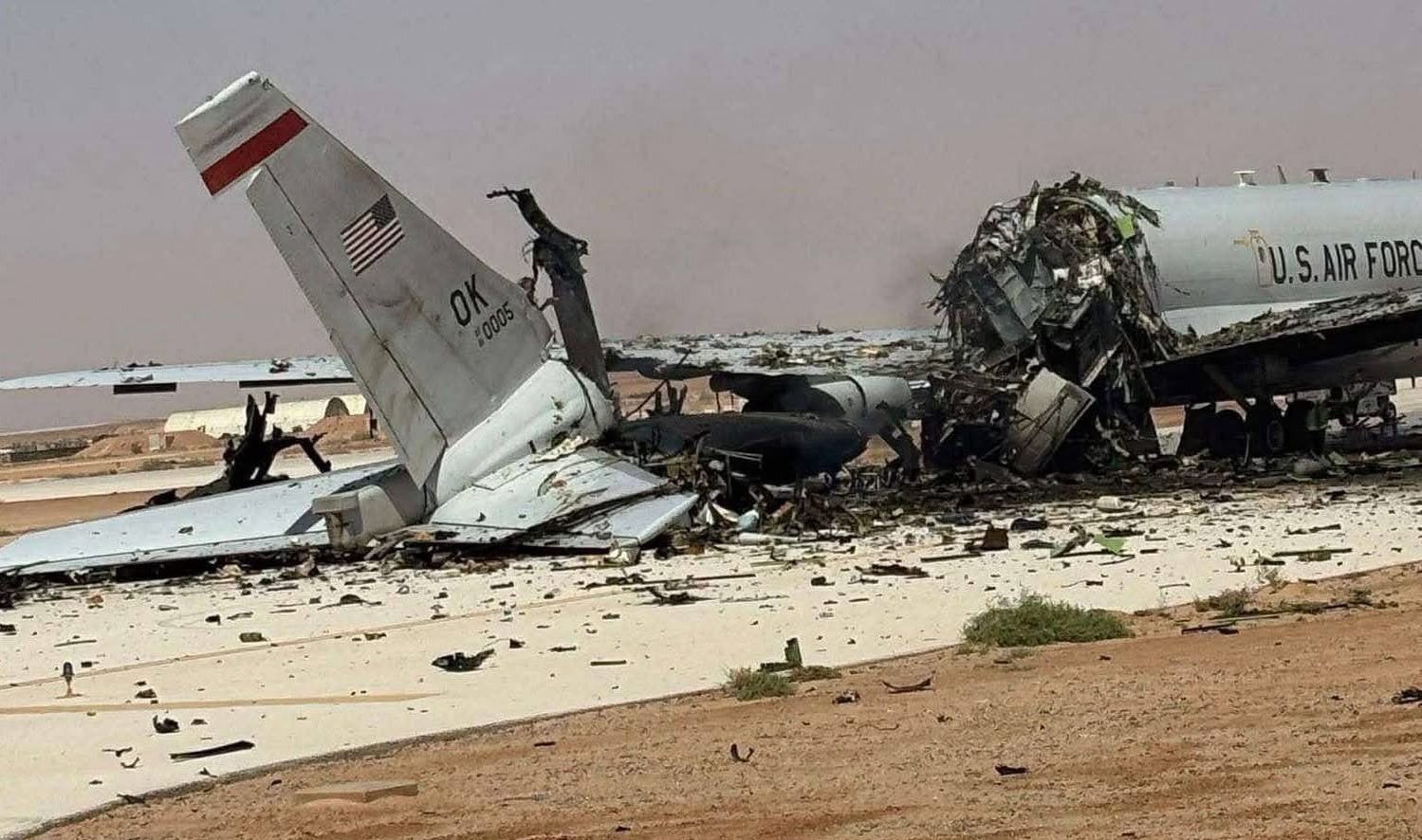
Last Friday, Iran destroyed an American E-3 Sentry aircraft on the tarmac at the Prince Sultan Air Base, deep inside Saudi Arabia. Besides its own role in air defence, this airborne warning and control system (AWACS) plane had a price tag of about $300 million in the 1990s, and could cost double that to replace today.
Iran said a Shahed was used, and the US has not contradicted that claim. The Iranian strike drone, also used extensively by Russia in Ukraine, can be manufactured for as little as $20,000 – more than 10,000 times less than the target it destroyed.
Economic targets are just as vulnerable. On Monday, a Shahed struck and set ablaze a Kuwaiti oil tanker laden with crude oil as it lay at anchor off the coast of Dubai. As Phillips O’Brien has pointed out, the total cost is in the same bracket as an AWACS: about $150 million for the ship, and $200 million for its cargo. And there are perhaps 200 tankers trapped in the Gulf.
While the Shahed has caused trouble for Ukraine, the Gulf theatre shows the full extent of its transformative power. It has brought a large number of soft, expensive targets into range which cannot all be adequately defended with current systems. And unlike missiles it can be built in a garage, meaning its production cannot be halted by air power alone.
Rush for countermeasures
The race is on to find a reliable and cost-efficient countermeasure, both to meet demand in the Gulf and to limit the effectiveness of strike drones in any future conflict. And while the initial developments are taking place in the military domain, the vulnerability of critical infrastructure will eventually require a broader societal response.
In the purely military sphere, companies are developing a range of systems to detect, track and engage strike drones at scale, without scrambling fighter jets or expending multimillion-euro interceptors each time.
Young European companies are developing low-cost interceptor missiles and drones designed primarily to hit Shahed-like targets for a few thousand euros per fire. Germany’s Quantum Systems has partnered with Ukraine’s WIY Drones to scale production of the latter’s Strila interceptor – and won a contract to supply 15,000 of them to Ukraine.
The biggest companies are also taking part. Airbus this week tested an autonomous aircraft, Bird of Prey, designed to search and destroy strike drones. Armed with low-cost Mark 1 missiles built by Estonian start-up Frankenburg Technologies, the Bird of Prey can potentially destroy up to eight Shaheds in a single sortie before landing safely for reuse.
Early detection is a key component of successful interception, and here Europe’s fragmentation is a weakness. Europe’s various armed forces currently lack the ability to coordinate effectively with each other, especially in a scenario without American leadership through NATO, reducing the chance of strike drones being tracked and intercepted as they overfly several territories.
The bomber will always get through
Coordination will also have to improve between the military and civilian domains, recognising that the armed forces will not be able to intercept every drone in a conflict at scale. In 2022, Ukraine introduced an app called Eppo which allowed civilians to flag drone and missile sightings to the Air Force, rounding out an often incomplete radar picture.
Civilians may have a role to play in defeating drones, as well as detecting them. Strike drones carry a smaller payload than ballistic missiles, and their effectiveness can be significantly reduced by measures as simple as reinforcing structures. Since early in the war, Ukrainian critical infrastructure has been hardened in this way.
More recently, Ukraine has authorised civilian infrastructure operators to buy and operate air defence systems. In coordination with the Air Force, employees of a power plant or train station can shoot down inbound strike drones – and have begun successfully to do so in recent weeks, Defence Minister Mykhailo Fedorov said this week.
The idea is beginning to catch on elsewhere in Europe. The Czech government is considering giving infrastructure operators the authority to use air defence systems – to counter both strike drones and smaller, locally operated models that can disrupt airports or conduct surveillance of strategic locations.
Too late for the Gulf
Bringing new countermeasures online will take time. Back in the Gulf, the US and its allies seem to have no answer to the Shahed. That leaves three scenarios: a continuation of the status quo, a negotiated peace to Iran’s advantage, or an escalation into a ground war.
All three of these scenarios will leave the Strait of Hormuz closed, oil prices high, American credibility degraded and NATO under pressure. Vladimir Putin will be flush with cash and eager to press his advantage – meaning Europe has no time to lose.
In the news
Cross-border defence procurement deals are more likely to succeed if companies commit to manufacturing in the target market, Belgium’s defence minister Theo Francken said.
The EU’s External Action Service is planning to issue guidance on how Article 42.7 of the EU treaty – the bloc’s equivalent to NATO’s Article 5 – can be activated, Euractiv reported.
Ukraine’s air defences shot down 89.9% of Russian drones and missiles in March, the defence ministry said, up from 85.6% in February.
The European Defence Agency (EDA) has hired Anders Sjöborg as its deputy chief executive, whose roles will include increasing support for joint procurement.
Poland’s state arms manufacturer PGZ is to build anti-drone interceptors developed by Estonian startup Frankenburg Technologies in order to scale up production.
Slovakia produced hundreds of thousands of artillery shells last year, and has increased its exports by 2,200% in the past four years, Bloomberg reported.
Further reading
The International Institute for Strategic Studies (IISS) has a long read on how UAVs are used in intelligence, surveillance and reconnaissance (ISR).
The scenario of Iranians rising up against the regime following US and Israeli airstrikes has “withered on the vine” and the likelihood of an Islamic Revolutionary Guards Corps (IRGC) dictatorship is “ascendant”, Graeme Herd wrote for RUSI.
Iran’s ability to fire ballistic missiles at targets up to 4,000km away is largely symbolic but could still change the geopolitical picture, Markus Schiller said in an interview with the Stockholm International Peace Research Institute (SIPRI).
I saw down with Julia Kril for a chat about Europe’s defence industry and the war in Iran.
Thank you for reading The Sentinel. To receive all of our free news and analysis, subscribe by clicking the button below.
If you’d like to submit an op-ed, or are interested in a full subscription when they become available, please email sam@thesentinel.eu.