
The Sentinel Weekly: Forward deterrence
Plus demand for interceptors, cross-border business, Iran strategy and more

European efforts to forge a joint security architecture took a step forward this week with Emmanuel Macron’s announcement of an extended French nuclear posture and a series of partnerships to expand both nuclear and conventional deterrence.
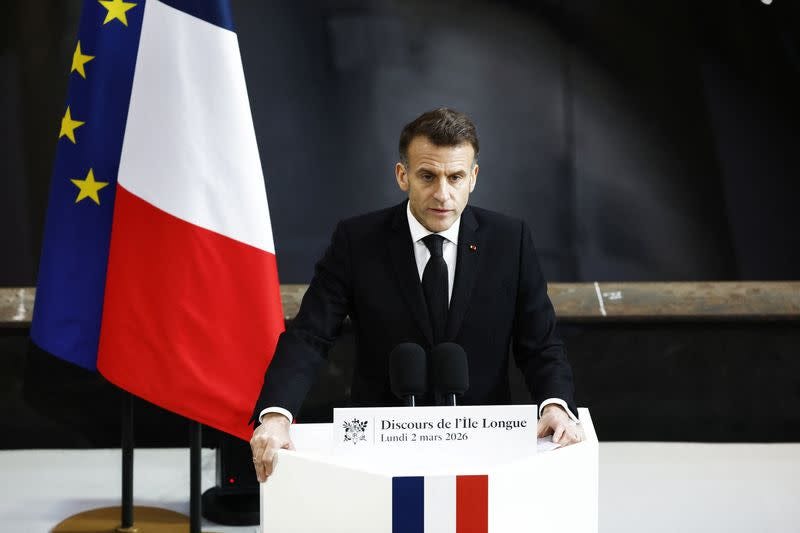
Standing in front of a nuclear submarine at the Atlantic base of Ile Longue, the French president noted the breakdown of global rules and the recent increase in security risks including nuclear proliferation. In response, he announced an increase in the number of French warheads and said that details of its stockpile would no longer be public.
More importantly for European allies, he set out a new doctrine of “forward deterrence” that will allow French nuclear-armed fighter jets to deploy to other countries, and for those countries to take part in joint exercises involving French nuclear forces.
There are a host of caveats. Allies will contribute only to conventional elements of nuclear exercises and there will be no shared decision-making on the use of nuclear weapons: “the final decision lies in the hands of the President of the Republic alone”. The definition of “vital interests” that might trigger the use of nuclear force will remain entirely French, and confidential.
Those same caveats apply to the United States, which also hosts air-launched nuclear weapons on European soil and leads joint exercises. As Europe’s interests diverge from America’s and leaders doubt Washington’s commitment to the Atlantic alliance, France is positioning itself to step into the vacuum.
Post-American order
While Macron paid lip service on Monday to NATO’s “complementary” nuclear mission, he made clear that the US should no longer be seen as a reliable guarantor of European security. “Their recent national security and defence strategies illustrate a reordering of US priorities and are a strong incentive for Europe to address its own security more directly,” he said.
There are indications that other European countries, which have long rebuffed French pretensions to continental leadership, are coming around. Macron said on Monday that eight countries have entered into a “dialogue” with France on shared deterrence: the UK, Germany, Poland, the Netherlands, Belgium, Greece, Sweden and Denmark.
Getting the Germans on board was a particular diplomatic coup for France, particularly in light of ongoing disagreements over the FCAS joint fighter jet program. In a joint statement on Monday, Macron and German Chancellor Friedrich Merz announced the creation of a “high-ranking nuclear steering group” and said that Germany would participate in French nuclear exercises beginning this year.
The statement paid extended tribute to NATO and to US capabilities forward-deployed in Europe, whose largest contingent is in Germany. Still, the agreement with France shows Germany at least beginning to hedge against the potential unravelling of the Atlantic alliance. The participation of Poland, the most Atlanticist of Europe’s big countries, is equally revealing.
Conventional coup
France’s offer to extend limited access to its nuclear exercises may also help it establish a leading role in conventional deterrence, much of which uses the same systems and exists on the same escalation ladder as nuclear strategy.
Macron’s joint statement with Merz said that “France and Germany will also increase their ability, as Europeans, to manage escalation beneath the nuclear threshold – in particular in the fields of Early Warning and Air Defence and Deep Precision Strike.” By putting its unique nuclear capability on the table, France can guarantee itself a leadership role in any joint exercises or operational command chains that include a nuclear option.
The inclusion of Sweden in France’s list of partners is also noteworthy because it has recently begun openly talking about restarting its own nuclear program, suspended in 1968, in partnership with other Nordic countries and perhaps Germany. By bringing Sweden inside the tent, France may have reduced the urgency of those conversations.
Still, France’s nuclear guarantee for Europe is far from absolute. French doctrine makes no allowance for tactical nuclear weapons, instead maintaining the threat of an annihilation strike and ambiguity about what might trigger its use. Macron reiterated that stance on Monday: “France… has abandoned any notion of tactical use of nuclear weapons and we will not go back on this.”
That logic makes sense as a last-ditch guarantee of French independence without a superpower budget. It’s not clear whether it will be sufficient to deter limited nuclear escalation by the likes of Vladimir Putin, who might reasonably calculate that France wouldn’t engage in mutually assured destruction in response to a battlefield nuclear strike.
A fully effective European nuclear deterrent would require tactical escalation options as well as a usage doctrine based on European interests rather than those of one country. France’s forward deterrent has neither – but is still a welcome step towards security independence and a more joined-up conventional deterrent.
In the news
The US and at least one GCC country are looking to buy interceptors from Ukraine to counter Iranian Shahed drones, the Financial Times reported, offering an opportunity to Ukrainian and other European start-ups making low-cost interceptors. Existing US missiles are advanced but extremely expensive, making them ill-suited to countering waves of low-cost drones.
Ukraine may suffer from globally depleted stocks of air defence interceptors, since it faces competing demand from the US and GCC states, EU foreign policy chief Kaja Kallas has said.
The European Commission will this month propose the ‘28th regime’ allowing companies to operate across the EU under a single set of rules, President Ursula von der Leyen said on Wednesday – a development that could help young defence companies secure funding and scale up across borders.
The FCAS project will be “dead” if Airbus doesn’t change its stance, Dassault CEO Eric Trappier said this week, claiming that the German partner “doesn’t want to work with Dassault”. Airbus has previously accused the French firm of trying to change the agreed terms of the deal.
Three US F-15 fighter jets downed in Kuwait may have been mistakenly shot down by a single Kuwaiti fighter pilot rather than ground-based air defences as first assumed, the Wall Street Journal reported.
The US has lifted some sanctions on Russian oil to offset the closure of the Strait of Hormuz.
Further reading
European defence procurement is heavily concentrated in favour of the top ten companies – much more so than in the US – and policymakers should devise ways to include innovative young companies, Ethan Kapstein, Javier Octavio Ospital Greslebin and Guntram B. Wolff wrote for Bruegel.
The positive reactions around Europe to Macron’s nuclear deterrence speech show extensive diplomatic preparation as well as a changed strategic environment, Claude-France Arnould wrote for the Brussels Institute for Geopolitics.
European deterrence depends as much on shared conventional capabilities as on the extension of France’s nuclear umbrella, Luigi Scazzieri wrote for the EU Institute for Security Studies.
The Iranian regime will need to be able to declare victory internally if there is to be any hope of a ceasefire in the Middle East, Mark Urban wrote on his Substack.
The Trump administration appears to have no strategy for a long war in Iran, or even clear war aims, Daniel Drezner wrote on Substack.
Iran appears to be losing its ability to launch missiles and its production capacity for Shahed drones is limited, meaning it’s unlikely to overwhelm US, Israeli and GCC air defences, Phillips O’Brien wrote on Substack.
Thank you for reading The Sentinel. To receive all of our free news and analysis, subscribe by clicking the button below.
If you’d like to submit an op-ed, or are interested in a full subscription when they become available, please email sam@the-sentinel.eu.