
The Sentinel Weekly: Nordic nukes
Plus a big defence IPO, troops in Greenland, de-risking from America, and more

The Nordic countries, best known for their enviable living standards, also enjoy a reputation for a fierce fighting spirit that makes them a hard target for aggression, from Finland’s heroic stand in the Winter War to Denmark’s outsized contribution to NATO efforts in Afghanistan and, most recently, Sweden’s overt civil defence preparations.
Now, with the US no longer a reliable guarantor of European security, the Nordic porcupine may soon grow another quill: nuclear weapons.
Russia’s progressive return to expansionism, combined with America’s turn away from Atlanticism, has resurrected Cold War-era debates about nuclear deterrence which had all but vanished after the fall of the Berlin Wall.
The logic of escalation management and mutually assured destruction is a grimly fascinating topic that’s worth some deep reading. Lawrence Freedman’s Strategy has an excellent section on this topic, while Abyss by Max Hastings gives an in-depth account of nuclear decision-making during the Cuban Missile Crisis.
Two questions in particular come to the fore, whose answers provide the logic for Nordic nukes. The first is whether a shared deterrent is truly credible: Would the US would really risk New York to save Stockholm, or indeed would France or Britain order a nuclear strike to avenge Helsinki? One of America’s great triumphs during the Cold War was reassuring its allies that it would. It no longer does so.
Europe’s two nuclear powers, meanwhile, lack America’s capacity to completely annihilate Russia but would themselves suffer that fate in a nuclear exchange. When the assured destruction is not mutual, the deterrent is less credible.
The second question concerns escalation dominance, the theory that a nuclear power must be able to match its adversary at every rung of the ladder in order to provide an effective deterrent. If it is attacked at a level where it can’t retaliate in kind, it must either suffer the loss or escalate further (this logic also applies outside the nuclear domain in hybrid warfare).
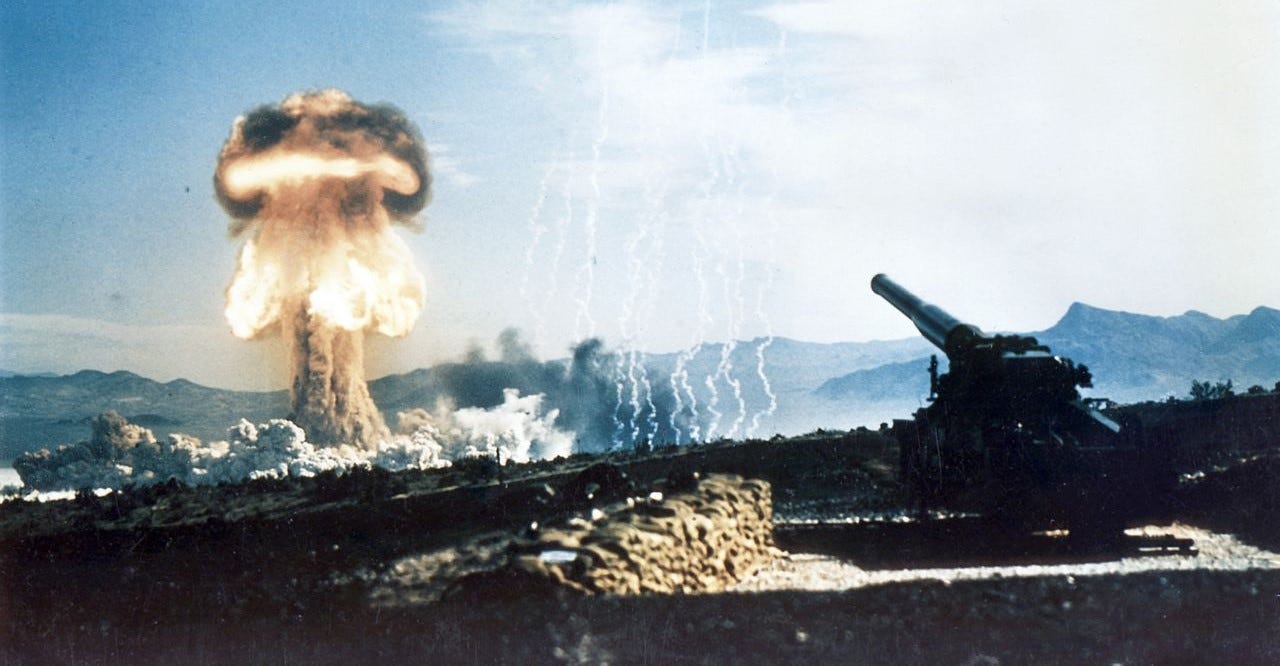
Tomi Huhtanen, the executive director of the Wilfried Martens Centre, gave an example of this in a LinkedIn post this week about a potential Nordic-German nuclear capability. He noted that European armies have no answer to a limited nuclear strike against military formations, as opposed to a strategic attack on cities with ICBMs.
“If Putin is forced to choose between losing a conventional war or using a tactical nuclear strike to force a negotiation from a position of strength, what will he do?” Huhtanen asks.
Filling the escalation gap
This is the gap that Nordic countries should seek to fill, he says, because an “integrated European solution” – his preferred long-term outcome – will take too long. A Russian attack on EU territory could credibly come as soon as 2028.
Sweden would be best placed to lead these efforts because of its advanced defence industry, its history of developing nuclear weapons, and a public discourse that is already receptive to such a step.
For its population of less than 11 million, Sweden has a remarkably advanced defence industry. It is by far the smallest country that builds its own fighter jet – the well-regarded Saab Gripen, which has found buyers from Brazil to Thailand.
Sweden’s culture of total defence, meanwhile, means the thought of developing nuclear weapons is not outlandish. Since 2018 it has issued residents with a civil defence brochure, updated in 2024, stating that the country will “never surrender” if attacked and informing citizens of what to do in a range of scenarios including a nuclear strike.
In early 2025, the left-leaning newspaper Dagens Nyheter proposed developing a Swedish or Nordic nuclear deterrent rather than relying on France. At the time, most Swedes preferred an EU-wide deterrent, according to Johan Wennstrom, a researcher at the Swedish Defence University; but with the threat becoming more acute, a Nordic solution could win public approval.
Beyond its impressive arms industry, Sweden has specific experience of developing nuclear weapons. For more than two decades after the Second World War, it worked towards building an indigenous atom bomb using its own uranium deposits and deployable by its own jet fighters.
Sweden abandoned its nuclear ambitions when its signed the Non-Proliferation Treaty in 1968, but it retains an active civilian nuclear industry. A ban on mining uranium was lifted in November last year. A Nordic nuclear deterrent is no longer as unthinkable as it once was.
In the news
Czechoslovak Group announced plans to list its shares in Amsterdam in what could be one of Europe’s biggest IPOs of the year. The company, which makes ammunition and other military equipment, will issue €750 million of new shares and sell an unspecified number of existing shares. The flotation could value the group at about €30 billion.
European countries should radically restructure at least part of their armed forces into an EU-wide military, which would be much stronger than the 27 separate “bonsai armies” that currently exist, EU Defence Commissioner Andrius Kubilius said in a speech on Sunday. He suggested a starting force of 100,000 troops under joint command, equivalent to the US forces currently stationed in Europe.
Five European countries including Denmark are sending troops to Greenland to act as a tripwire against a US invasion. The contingents are small and would quickly be overrun, but their presence means any attack would put the US in conflict with multiple NATO allies. Danish troops have standing orders to engage any invading force.
The European Commission formally proposed the €90 billion loan to Ukraine that EU members agreed to in principle last month. President Ursula von der Leyen said there would be a preference for European arms purchases, but the loan could also be spent abroad.
The EU is “building up to be a military powerhouse”, Von der Leyen told MEPs from her EPP group, Euractiv reported, pointing to defence funding and joint procurement programs.
British special forces are being prepared to seize Russian shadow fleet tankers, the Times reported. The UK is situated along Russia’s main shipping routes, and last week provided logistical support to US forces seizing a Russia-linked tanker in the North Atlantic.
Naval drones struck at least two oil tankers in the Black Sea, including one chartered to US oil company Chevron. They were heading to Yuzhnaya Ozereyevka, a Russian terminal that handles Kazakh oil exports. Shipping insurance costs for the Black Sea nearly doubled, Reuters reported.
Rheinmetall will provide Lynx infantry fighting vehicles to Ukraine, paid for by Germany. The initial order is for five vehicles.
UK satellite company Open Cosmos has won the rights to a low Earth orbit frequency used for military intelligence as well as consumer internet.
Further reading
European businesses are likely to pressure politicians to be allowed to return to Russia, if the US continues it policy of normalisation, Charles Hecker wrote in an op-ed for The Sentinel.
Jens Stoltenberg’s autobiography is well worth a read. From negotiating with the Russians to the chaotic withdrawal from Afghanistan, the former NATO Secretary General is refreshingly forthright. I was surprised by the extent to which Donald Trump was destabilising NATO as early as 2017.
European countries can resist American aggression towards Greenland by standing together in support of diplomatic norms and by progressively loosening their dependence on the US, Tim Haesebrouck wrote for the Egmont Institute.
“Pacifying Donald Trump only gets you so far” and Europe should aim to “de-risk” from the US, even if this means moving closer to China, Ed Luce wrote for the FT.
Europe must call Trump’s bluff and stand up to his “bullying”, former Economist editor Bill Emmott wrote on his Substack. It should also ramp up support to Ukraine, not least to keep Russia occupied while the “transatlantic divorce” is taking place.
Thank you for reading The Sentinel. To receive all of our free news and analysis, subscribe by clicking the button below.
If you’d like to submit an op-ed, or are interested in a full subscription when they become available, please email sam@the-sentinel.eu.