
The Sentinel Weekly: With friends like these
Plus European diplomacy, frozen Russian assets, Polish submarines and more

Europe has been shaken by the Trump administration’s endorsement of a 28-point ‘peace plan’ that would carve up Ukraine, limit the size of its forces, and prevent it from joining NATO or hosting allied troops.
Linguists quickly surmised that the clunky English text was likely a translation from Russian. Allowing Moscow to frame the deal was shocking enough, but perhaps even more telling was the shoddy translation and lack of proofreading (the second point refers to a “comprehensive and comprehensive non-aggression agreement”). America’s civil service would not have made such a blunder, suggesting that it has been frozen out of the process.
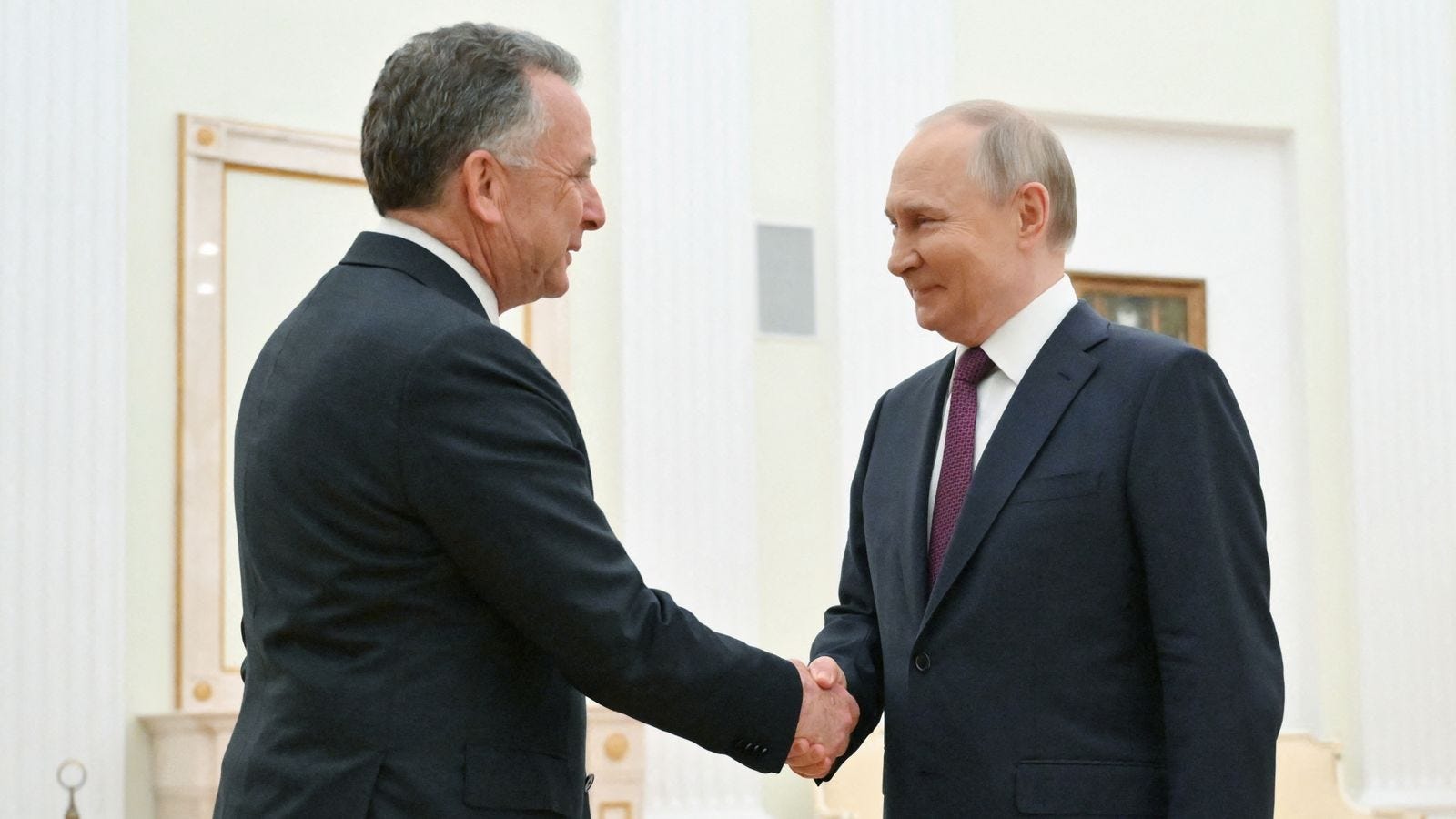
A few days later, Bloomberg reported that Donald Trump’s ‘special envoy’ Steve Witkoff had briefed the Kremlin on how Vladimir Putin could best persuade the US president to endorse the deal.
European leaders pushed back on the deal and Trump, under pressure from US senators, softened his Thursday deadline for Ukraine to accept it. At the time of writing, nothing has been agreed.
But the past week has shown that the White House is seriously entertaining the idea of abandoning Ukraine. That would not only be a tragedy for the Ukrainians; it could set the scene for Russia to attack European NATO members a few years down the line.
Signalling weakness
This scenario was laid out in a book published over the summer, titled If Russia Wins. Carlo Masala, a German professor, imagined what might follow if the US forced a bad peace deal on Ukraine.
In Masala’s scenario, Russia deduces that the US is not fully committed to protecting European territory, including within NATO, and European allies are unable to do so. Hawks around the Russian president devise a ‘NATO stress test’, a limited act of aggression that is likely to succeed but can be reversed if necessary.
In March 2028, Russia invades the Estonian border city of Narva on the pretext of protecting its ethnically Russian residents. It also occupies the island of Hiiumaa and carries out a series of hybrid attacks across Europe.
In this fictional timeline, which is worth reading in full, Russia succeeds. The US exerts some pressure on Russia but the president makes clear that he is “not about to risk a Third World War over a small Estonian town”. European leaders are divided, but soon realise that they’re unable to dislodge the Russian invaders without extensive US support. The map is redrawn.
Setting a precedent
If Russia were to annex territory from a NATO country, however small, a precedent would be set. Once collective deterrence is no longer seen as absolute, Russia will be free to annex more territories on historical pretexts or openly meddle in the affairs of former Warsaw Pact members.
To avoid this fate, European powers need to ensure that Russia dare not take that first bite at NATO. With the reliability of the US now in serious doubt, that means developing an independent capability to fight back as a credible deterrent.
In Masala’s story, the debate over whether to repel the invasion of Narva is quickly shut down by a US declaration that it won’t take part, making the operation impossible. The US need not actually veto an Article 5 declaration; it can just signal that it won’t take the lead and the motion will fall apart.
If by contrast European allies had the operational capability to repel a Russian invasion, the US would not have such an outsized presence at the NATO negotiating table. European leaders could declare an intention to act, draw up a credible battle plan, and give the US the choice of whether to commit its forces or simply give its moral assent under Article 5.
That need not – and should not – mean cutting the US out of the equation. Any retaliation against Russian aggression should happen under Article 5 and should ideally involve US troops, not least to maintain credible deterrence against nuclear escalation. But an independent European capability is necessary to encourage, and if necessary shame the US into honouring its treaty obligations.
Filling the gaps
Credible deterrence means having an offensive as well as defensive capability. Russia has the means to invade islands or limited pockets of land without the sort of major build-up that preceded the full-scale invasion of Ukraine. In Masala’s scenario, Russian forces are able to take Narva and Hiiumaa in a surprise attack. European forces must be able to dislodge them.
In the first instance, that means being able to quickly and securely move troops and equipment to any potential flashpoint, overcoming any attempts at interference such as a Baltic Sea blockade or railway sabotage. NATO’s target is for initial forces to arrive in theatre within 10 days; European logistics capabilities are currently far short of that, as The Sentinel wrote last week.
European forces would then need to defeat the occupying Russian troops, including any reinforcements that might be sent. That would be very difficult without at least two capabilities that they currently lack: airborne surveillance (AWACS) to establish air superiority and control the battlespace, and precision deep strike to destroy supply hubs inside Russian territory.
Without these capabilities, Russia is free to shatter NATO and redraw the map of Europe if only it can convince the US to look the other way. With a credible deterrent in place, it might not even try.
In the news
France will introduce voluntary military service for its young citizens, beginning in summer 2026, President Emmanuel Macron said. After training, the recruits will be integrated into regular military units for the duration of their service.
NATO is investigating corruption allegations centred on its procurement arm, the NATO Support and Procurement Agency (NSPA), Follow The Money reported.
Poland might deploy drones to protect its critical infrastructure following last week’s sabotage attack on a railway line, the FT reported.
The European Commission is preparing a legal instrument to seize €185 billion in Russian bank assets currently frozen in Europe, to fund the defence of Ukraine, President Ursula von der Leyen said. The prime minister of Belgium, which holds most of the funds, pushed back strongly on Thursday, Politico reported.
Poland has chosen Saab to provide its next-generation submarines, with a contract to be signed soon. Saab’s CEO said the Blekinge-class hunter-killer submarine, also known as type A26, is “tailored for the Baltic Sea”.
Testing of the UK’s Ajax armoured vehicle, made by General Dynamics, has once again been halted after excessive noise and vibration caused soldiers inside to become unwell.
France’s Dassault and Thales announced a partnership to develop “controlled and supervised AI for defence aeronautics”.
The European Parliament approved the €1.5 billion European Defence Industry Programme (EDIP), encouraging cross-border defence investment in Europe; Ukrainian firms can also take part.
European leaders are considering hybrid actions against Russia including cyberattacks and provocative exercises near its border, in response to a recent uptick in Russian hybrid activity against Europe, Politico reported.
NATO navies are experimenting with signalling lasers, developed by Lithuania’s Astrolight, which are impossible to jam and harder to detect than radio communications, The Resilient reported.
Rheinmetall will use mixed-reality technology provided by Finland’s Varjo to train drivers on its military vehicles.
Point of view: Europe’s defunct diplomacy
European diplomacy is “continually in pursuit” of agendas set by other powers, the Egmont Institute’s Sven Biscop wrote in a policy paper this week, referring to the Ukraine peace plan but also to relationships with China, Turkey and others.
After decades of being loyal allies to the US, Biscop describes a sort of learned helplessness among European leaders. While many have begun to realise that their interests are diverging from those of the US and that they need to act independently, they seem to have forgotten how to do so: “the habit of never acting without active US support has made many entirely risk-averse.”
Ahead of this week’s talks on Ukraine, Europe “did not even prepare its own negotiating position, let alone try to take the initiative itself,” Biscop writes. Therefore, “once again, Europe is now forced to scramble in reaction to a US initiative”.
With the US no longer enforcing a unipolar world order, Biscop makes the case for the EU to pursue big-power diplomacy, taking a robust stance with other big powers and competing for influence in nearby regions to promote stability and gain access to resources and markets.
What many Europeans have forgotten, he writes, is that “power is indivisible ... Europe will not be able to exercise its political and economic power to full effect if it does not have military power as well.”
Thank you for reading The Sentinel. To receive all of our free news and analysis, subscribe by clicking the button below.
If you’d like to submit an op-ed, or are interested in a full subscription when they become available, please email sam@the-sentinel.eu.