
The Sentinel Weekly: Truth to power
Plus new investment funds, Renault drones, hybrid war financing, and more

Donald Trump’s dramatic climbdown over Greenland was only the second-most important speech at Davos this week. A day earlier, Canadian Prime Minister Mark Carney gave an incisive diagnosis of the new world order and what it means for middle powers – including their defence policy.
On Wednesday, Trump declared that he would neither use force to take Greenland nor impose tariffs on European countries who dared to defend it. He claimed to have reached the outline of a deal with NATO Secretary General Mark Rutte, which may turn out to be little different than the existing pact that already gives the US military access to the territory.
Trump’s retreat followed market jitters and unusually robust words from European leaders; the obvious conclusion is that he was looking for a victim rather than a fight. He had backed down just as abruptly in April against China, which had squared up and matched his tariffs blow by blow, before a market rout led him to abandon the idea globally.
But if the best response to Trump’s threats is to say “try it and find out”, Europe’s military weakness remains a problem. As anyone who has studied martial arts will tell you, it’s much easier to stare down a bully when you know you could survive the fight. And that’s where Carney comes in.
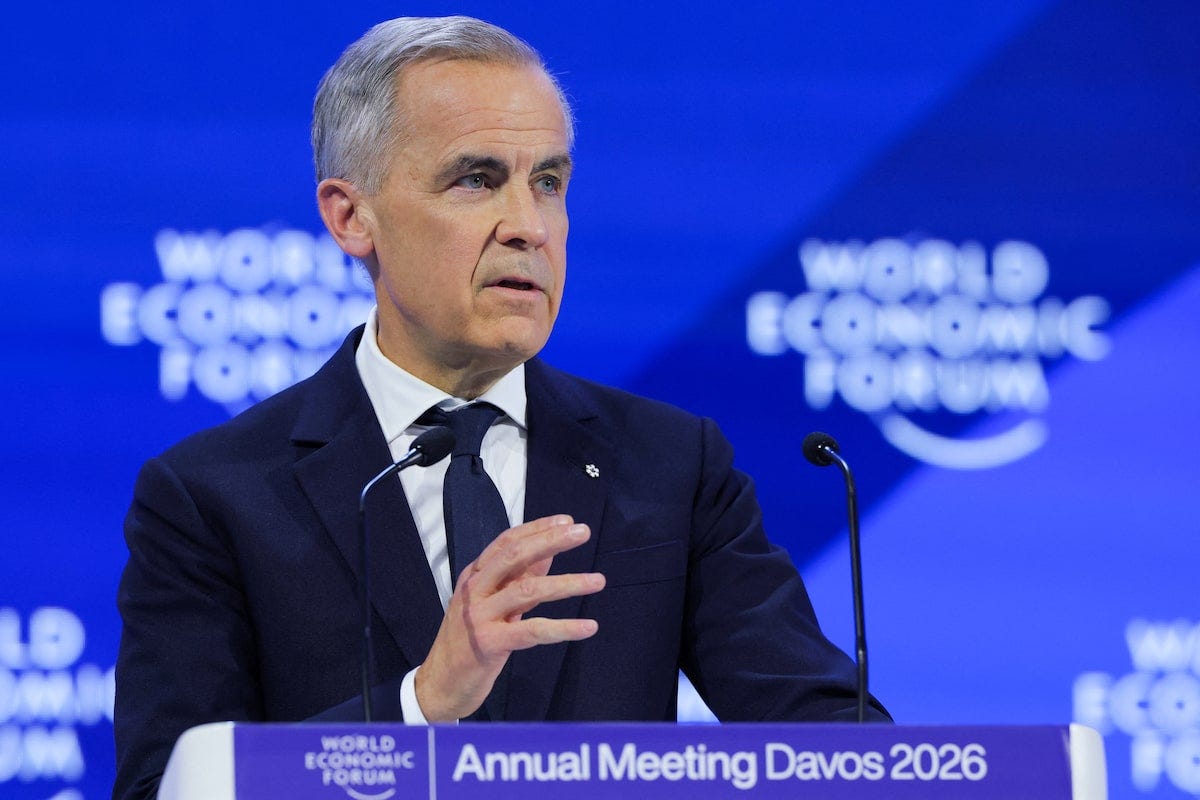
In his 15-minute speech on Wednesday, which it’s worth watching or reading in full, Carney made the case it’s no longer enough for middle powers to “go along to get along”. The “fiction” of the rules-based international order was tolerable when American hegemony was used responsibly, but now “this bargain no longer works”.
The instinctive response to this reversion to historical norms would be for countries to put up walls and pursue strategic autonomy, accepting a little poverty as the price of resilience, he said. But mid-sized powers, already brought close by global institutions, have the chance to do something better: work closely with each other and engage cannily with the world beyond.
Strength in numbers
“Middle powers must act together because if we’re not at the table, we’re on the menu,” he said. “When we only negotiate bilaterally with a hegemon, we negotiate from weakness. We accept what’s offered. We compete with each other to be the most accommodating. This is not sovereignty. It’s the performance of sovereignty while accepting subordination.”
This is the key insight that many in Europe cannot admit: that middle powers cannot individually be truly sovereign. The illusion of sovereignty in the post-war period meant subordination to America, and America’s great trick was to never say it out loud. With the veil lifted, middle powers must pool their sovereignty or have none at all.
This is particularly true in defence, an area in which middle powers are especially eager to signal sovereignty, and especially unable to achieve it. As I wrote recently, Europe’s larger countries still insist on developing a full range of equipment individually due to misplaced notions of sovereignty. This, combined with fragmented and top-heavy command chains, makes European armed forces far less effective than their combined budgets would imply.
Carney this week recognised both the need to spend more on military power, and to allocate those funds more effectively. Canada is doubling its defence spending by 2030, he said, but also joining the EU’s SAFE program, which supports joint procurement efforts.
Supporters of the EU like to say that it is forged in crisis, that it emerges from each storm stronger and with new shared capabilities. The emerging security situation, with a belligerent Russia and an America that is disinterested at best, may yet prove to be the most existential threat since the EU’s creation.
Commission President Ursula von der Leyen and several national leaders have conducted themselves well over the past week and seen off an acute threat. But the broader challenge remains, and the real test will be whether the EU and its member countries – plus the likes of Canada and Britain – can make the necessary structural changes to integrate and multiply their military capabilities.
In the news
Czechoslovak Group’s forthcoming IPO will float up to 15.2% of its shares at a valuation of €25 billion, it said on Tuesday.
German investment firm DTCP is creating a new €500 million fund focused on defence start-ups, aiming to back around 30 companies with about €20 million each, Sifted reported.
Luminova Ventures, a Czech investment fund backing deep tech start-ups, is creating a new fund focused on dual-use technology.
Former tank manufacturer Renault has announced a partnership with French defence company Turgis Gaillard to produce drones for Ukraine.
Belgium has ordered eight bridge layers from Germany’s KNDS for a total value of about €80 million.
BAE Systems has won a contract worth more than £450 million to produce a new radar system for the UK’s fleet of Eurofighter Typhoon fighter jets.
Rolls-Royce has won an order for 350 engines for the Boxer armoured vehicle from Rheinmetall and KNDS.
The European Parliament has called for the mutual defence clause in the EU treaties to be operationalised, Euractiv reported, as trust in the US and NATO falls.
The French Navy on Thursday seized a Russia-linked oil tanker in the Mediterranean on suspicion of sailing under a false flag.
Further reading
Enforcement of EU competition policy is likely to take more account of geopolitical considerations, and is a source of European strategic power, Peter Beckett wrote in an op-ed for The Sentinel.
Russia uses a ‘gig economy’ models to carry out sabotage in Europe by recruiting agents with financial incentives for one-off operations, according to a new research paper by RUSI. It suggests pursuing cryptocurrency and cash-transfer platforms to curtail such attacks.
Michael Shurkin, a former CIA officer, laid out some Greenland scenarios on his Substack. He wrote before Trump’s climbdown, but the analysis is still relevant.
Thank you for reading The Sentinel. To receive all of our free news and analysis, subscribe by clicking the button below.
If you’d like to submit an op-ed, or are interested in a full subscription when they become available, please email sam@the-sentinel.eu.