
The Sentinel Weekly: The tanker war
Plus Russian assets, UK-EU talks, European satellites and more

After nearly four years of fighting, the conflict had ground to a grim, entrenched stalemate. Neither side was ready to make peace, but nor could they break through on the battlefield. Seeking a strategic advantage, they started targeting civilian shipping in an attempt to strangle each other’s economies.
Over the next four years, more than 400 civilian sailors lost their lives and a similar number of ships were damaged; dozens were sunk. The US intervened to protect its allies’ shipping. A new tactic was developed – swarming speedboat attacks – that would spread around the world and continue to menace shipping for decades to come.
The year was 1984, the belligerents Iraq and Iran. But nearly four years into Russia’s war on Ukraine, a spate of attacks on Russia-linked shipping raises the prospect of a new ‘tanker war’.
Last Friday, 28 November, Ukraine struck two oil tankers in Russia’s ‘shadow fleet’ – unacknowledged vessels used to evade sanctions – within an hour of each other in the Black Sea. The Kairos and the Virat, both flagged to Gambia, were in Turkey’s exclusive economic zone (EEZ) but not in its territorial waters.
Ukraine’s security service (SBU) claimed responsibility for the attacks, releasing footage of a naval suicide drone striking the side of a tanker. It said the tankers were sanctioned by the West and were empty, heading for the Russian port of Novorossiysk to take on cargoes of oil. An oil terminal at Novorossiysk was also struck.
Turkey criticised the attack the following day, and said it was working “with the relevant parties to prevent the spread and further escalation of the war across the Black Sea”. Kazakhstan, which ships oil from Novorossiysk, also spoke out against the attack.
Murky waters
Besides this relatively contained operation, however, two other attacks on Russian shipping took place, and were not claimed by Ukraine.
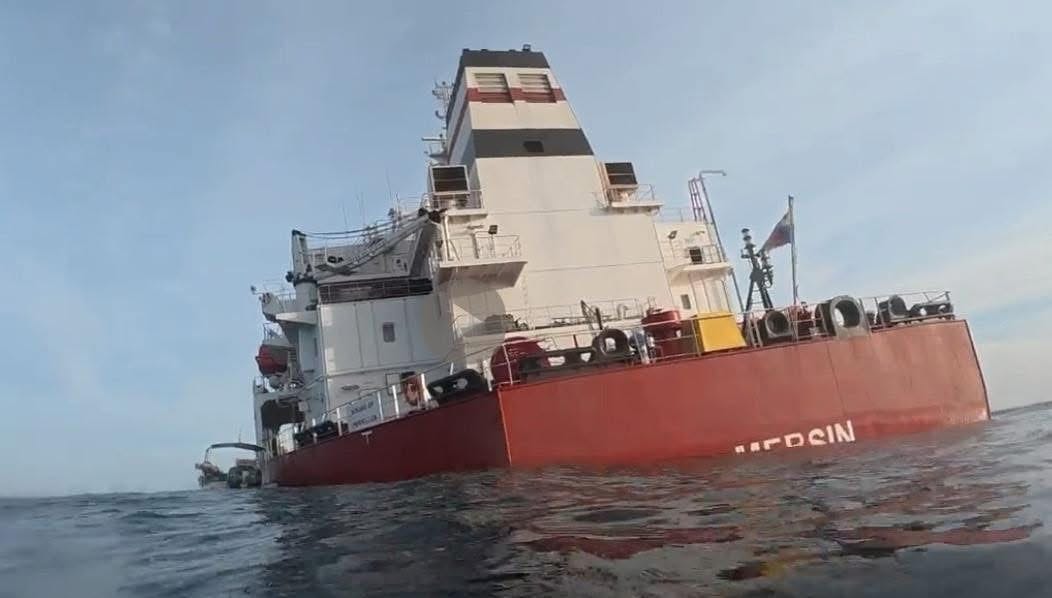
On Thursday 27 November the Mersin, a Panama-flagged products tanker, was struck off the coast of Senegal; news emerged several days later. This vessel was not sanctioned, though it had recently traded with Russia. Following the attack, the ship’s Turkish operator, Besiktas Shipping, said it would stop all operations with Russia. Ukraine hasn’t commented.
Finally on Tuesday 2 December, another tanker was struck in the Black Sea. This ship, the Midvolga-2, sailed under the Russian flag and was reportedly carrying a load of sunflower oil from Russia to Georgia.
On this occasion, Ukraine denied involvement and suggested it may have been a Russian false-flag operation. An attack on a vessel carrying foodstuffs rather than crude oil – and with a full cargo, increasing the risk of environmental damage – would mark an escalation.
“Ukraine has nothing to do with this incident, and we officially refute any allegations of such kind made by Russian propaganda. Furthermore, the alleged route from Russia to Georgia across Türkiye’s EEZ makes no sense – and suggests that Russia may have staged the whole thing,” foreign ministry spokesman Heorhii Tykhyi said on X.
Russian President Vladimir Putin accused Ukraine of “piracy” and threatened to attack ships belonging to countries that support Ukraine. Whatever the truth of what happened in the Black Sea and off the coast of Senegal, the risks to global shipping have increased.
A new threat
Naval suicide drones are a significant innovation, allowing deniable attacks at long range for the first time. By contrast, missiles and torpedoes can generally be tracked to a hostile vessel, aircraft or launchpad. Divers carrying limpet mines can attack a ship undetected, but it must be moving slowly and close to shore.
While Ukraine is the only known operator of naval drones, other countries are developing them and at least some models must be close to deployment. The latest version of Ukraine’s Sea Baby drone can carry a 2,000kg payload at a range of up to 1,500km.
The proliferation of such weapons will significantly increase the risks to civilian shipping, particularly in ‘hybrid’ scenarios where the attacker wishes to remain undetected. There are a great many lawless corners of the world, where naval drones could be smuggled or even assembled, within 1,500km of major shipping lanes.
Consider again the original tanker war. The speedboat tactics developed by Iran in the 1980s are still being used today by pirates around the world. Following a surge in piracy off the coast of Somalia in the 2000s, navies and coastguards adapted their tactics and a lucrative private security industry sprung up.
Naval drones could mark a similar turning point. Whoever can manufacture a reliable countermeasure probably won’t be short of buyers.
In the news
The European Commission proposed using up to €210 billion in frozen Russian assets to fund Ukraine’s war efforts, despite continued resistance from Belgium, which holds most of the funds. The EU also agreed to end Russian gas imports by 2027.
The UK walked away from talks to participate in the EU’s €150 billion Security Action for Europe (SAFE) loan scheme, which supports EU countries buying military equipment from companies based in the bloc, plus paying partners. The two sides were reportedly unable to agree on what price the UK should pay for access.
Canada reached a deal on Monday to take part in SAFE. The sum it paid was not disclosed, but Euractiv reported it to be just €10 million.
Poland launched its first military satellite on a SpaceX rocket on Saturday – a Synthetic Aperture Radar (SAR) satellite made by ICEYE of Finland, designed to work in weather conditions that would blind conventional satellites. ICEYE also sold an SAR satellite to the Portuguese Air Force this week.
Leonardo is “hungry like a wolf” to acquire defence start-ups, its strategy chief Simone Ungaro told Sifted.
Germany this week deployed Arrow interceptor missiles made by Israel at the Holzdorf airbase, south of Berlin, Tagesspiegel reported.
Sweden has bought an additional 94 6x6 armoured vehicles from Patria under the Finnish-led Common Armoured Vehicle System (CAVS), at a cost of around €140 million. Sweden’s total order now stands at 415 of the vehicles, with delivery to be completed by 2030.
Lithuania has ordered a third mobile air defence battery from Saab. The MSHORAD system comprises separate launcher, radar and command units, all mounted on Oshkosh 4x4 vehicles.
The UK and Norway announced a joint naval task force to hunt Russian submarines in the North Atlantic, using a combined fleet of Type-26 frigates made by BAE Systems.
Point of view: Free the funds
The EU “can change Ukraine’s fortunes” if it approves a reparation loan for Ukraine backed by frozen Russian assets, Ondrej Ditrych from the European Union Institute for Security Studies (EUISS) wrote last week.
Russia’s “performative” pursuit of peace, through a widely-derided 28-point plan cooked up with the Trump administration, is unlikely to end the fighting, he writes. The war will continue, and the reparation loan should be seen not as a future bargaining chip but rather “as one of Europe’s last chances to shape the war’s outcome”.
The funds should be disbursed immediately and should be spent directly on Ukraine’s defence, Ditrych argues. They should not be made conditional on any rule-of-law reforms, which are “worthy goals” but a distraction from the loan’s urgent military mission. The EU should support Ukraine’s other budgetary needs through a replenished Ukraine Facility.
Russia’s economy, while weakening, can stagger on for a long time – and probably longer than Ukraine’s, Ditrych writes. The EU should keep up the economic pressure on Russia, but also give Ukraine what it needs not only to survive on the battlefield, but to seize the initiative.
Thank you for reading The Sentinel. To receive all of our free news and analysis, subscribe by clicking the button below.
If you’d like to submit an op-ed, or are interested in a full subscription when they become available, please email sam@the-sentinel.eu.