
The Sentinel Weekly: Nordic tough love
Companies thrive when they’re allowed to fail

National champions, look away now. Sweden this week rejected a bid from Saab for its biggest defence contract in decades, instead ordering four frigates from France’s Naval Group.
There are many countries in Europe where that wouldn’t happen. The stated reasons vary – local jobs, sovereign capability, military-industrial cooperation – but the effect is the same: If a national champion bids for a contract in its home market, it’s likely to win it.
The cycle is hard to break. Economic theory suggests that if one country opens its market but its neighbours don’t, it risks putting its own companies out of business: If they’re competing fairly at home but are disadvantaged abroad, they’ll win fewer contracts and lose overall market share.
The Nordic model shows that in defence, a sector with many niches, this doesn’t necessarily hold true. By exposing their companies to competitive pressure, governments can foster creativity and thereby succeed on the global stage.
Representatives of several Nordic defence companies have told The Sentinel in recent weeks that they don’t receive any favours from their national governments – and in any case, their home markets are too small to sustain them alone. They must therefore compete fairly at home and also win contracts abroad, and these challenges share a solution: Find a niche and be the best at it.
Competitive pressure
Imagine a European country needs a new tank and its neighbour already builds an excellent model. In a protected market, a local company can still win the contract – perhaps under cover of thousands of design specifications – even if the result is more expensive and worse. But of course this vehicle won’t find any buyers on the export market; ultimately, the unearned win holds the company back.
In an open market, the local company would most likely lose the bid (or might not even try). But it could partner with the tank maker to provide components, or to make a variant better suited to its climate or doctrine. Or it could go off and build something else altogether. And by definition, if these specific capabilities don’t already exist, it stands a better chance of exporting them.
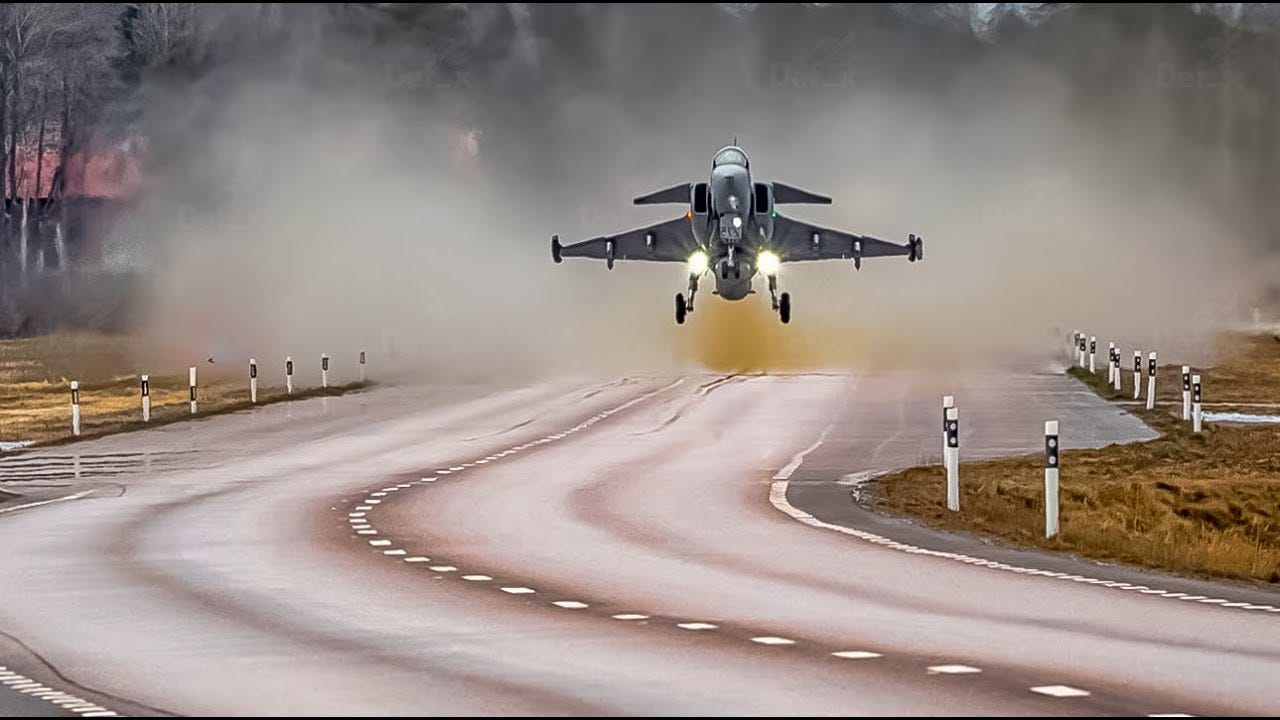
This model has underpinned the success of Saab and other Nordic defence firms for decades. Consider the Gripen fighter jet developed in the 1980s. While other very good fighters were available on the global market, they did not meet a key specification for the Swedish armed forces: the ability to use a short runway.
This was a crucial operating parameter, not a specification for its own sake. Sweden’s ‘total defence’ doctrine includes being able to convert rural roads into makeshift runways so its air force can disperse in the event of an attack. If a plane can’t land short enough, it’s not fit for purpose – so Saab got the nod to develop the Gripen.
Developing a fighter jet from scratch is an expensive business. But because the Gripen was built with meaningfully distinct specifications beyond ‘made in Sweden’, it found a competitive niche in the global market. Six other countries from Brazil to Thailand now operate the Gripen, and between them they have bought more units than Sweden.
Faster development
Now, as Europe rushes to rearm, more governments may adopt the Nordic model not only because it’s efficient, but also because it’s fast. If a foreign-made platform is ready for production, that may give it a winning edge over a local alternative with a multi-year development cycle ahead of it.
This factor appears to have weighed heavily on Sweden’s decision to award its frigate contract to Naval Group. The Frégate de Défense et d’Intervention (FDI) is already in production, and Naval Group indicated that Sweden could receive the first of its four ships in 2030 – quick work for a modern warship.
Announcing the contract award, Defence Minister Pål Jonson said the quick delivery timeline factored in the decision. He also noted that the FDI, already in service with the French and Greek navies, is a “proven system” – greatly reducing the risk of development delays and cost overruns.
As for Saab, there’ll be no corks popping in Linköping this week. But if history is a guide, its engineers will soon be back at work building something distinctively useful.
In the news
Air raid alerts were issued in Latvia and Lithuania over the past week as jammed Ukrainian drones strayed into their airspace, prompting political disputes.
Destinus and Rheinmetall have begun developing a precision strike drone with a range of 2,000km, a new European capability, and will begin testing next year.
German drone scale-up Stark is aiming to raise a “blockbuster” new financing round after winning a big government contract, Sifted reported.
Mercedes-Benz is considering a move into defence production, the Wall Street Journal reported, following similar conversations at Volkswagen.
Further reading
European defence officials have quietly begun to think about a ‘Plan B’ to coordinate their commands outside the US-led NATO framework, the Economist wrote.
Integrating European defence capabilities can be done in three ways, analyst at the Centre for European Policy Studies (CEPS) wrote: through NATO, within the EU, or by direct links between countries.
The Sentinel is a few weeks away from launch, when we will move on to our own platform and greatly expand our output. If you’re subscriber here, you’ll receive a weekly editor’s letter and will have access to a limited amount of content in front of our paywall.
If you’d like to submit an op-ed to be published after launch, or are interested in a full subscription when they become available, please email sam@thesentinel.eu.