
The Sentinel Weekly: Hungarian roulette
The 12 April election is of huge consequence to Europe

A scuppered loan to Ukraine, allegations of leaking sensitive information to Russia, a delayed SAFE package, and that’s just the past week.
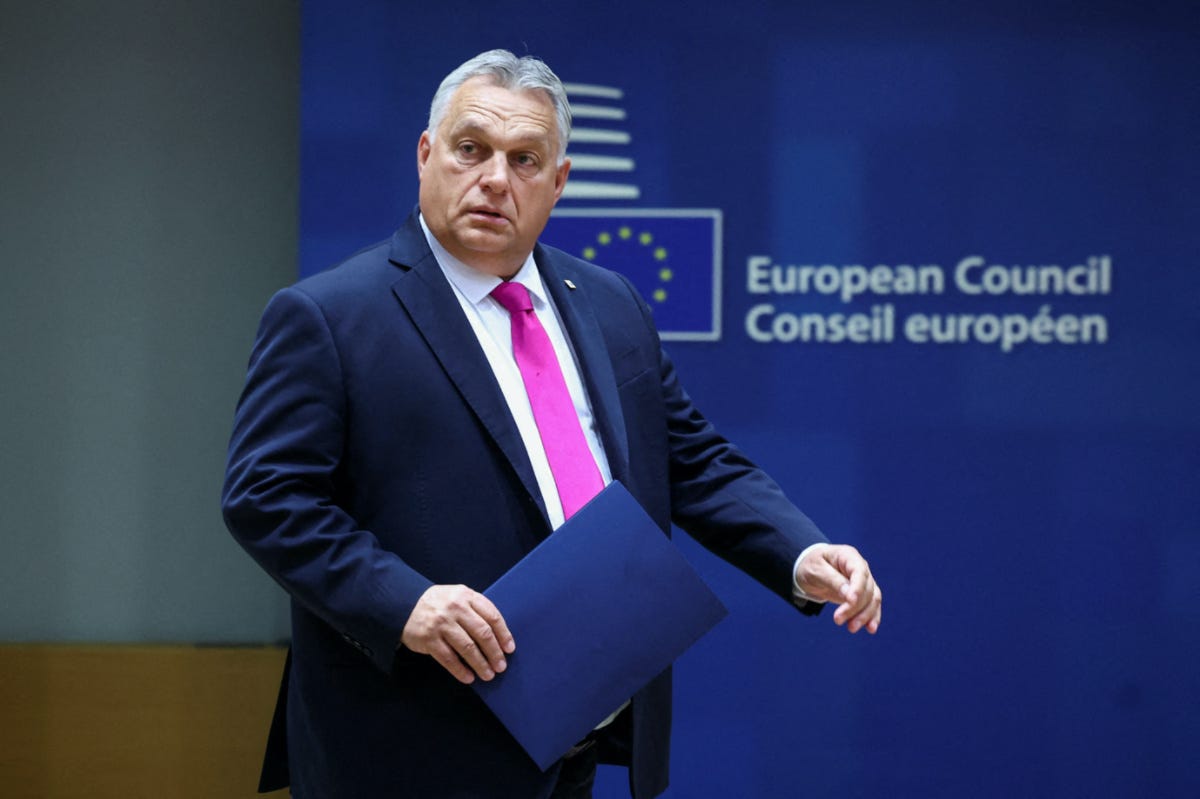
The Hungarian government is clashing with the EU on every front, and Viktor Orbán’s success or failure in retaining power next month will have a major effect on the bloc’s ability to act cohesively on questions of geopolitics and rearmament.
The election on 12 April will pit Orbán’s Fidesz party against the Tisza party led by Péter Magyar, a former ally who broke away from Fidesz in 2024 alleging widespread corruption. Tisza is leading in the polls but observers worry that Orbán, who has centralised power during his 16 years as prime minister, could use his control of state institutions to remain in power.
In recent months, Magyar has criticised the government’s close relations with Moscow and vowed to break Hungary’s dependence on Russian energy. He is not as closely aligned with Ukraine as some European leaders, but would be much less likely to unilaterally block Ukraine-related policies if he becomes prime minister.
By contrast, recent developments suggest that Orbán could make things even more difficult for the EU’s policy on Russia and Ukraine. Many in Brussels appear to have adopted a strategy of ‘wait until after the election’, both in the hope that Magyar wins, and to avoid letting Orbán play the martyr to EU overreach ahead of the vote.
Semper Fidesz
At last week’s EU Council summit, Orbán blocked a €90 billion EU loan to Ukraine after previously agreeing to it in December. All 26 other members agreed to the measure, including other occasional Ukraine holdouts Slovakia and Czechia, meaning Orbán’s veto was the only spoiler.
EU leaders gave unusual expressions of anger. Commission President Ursula von der Leyen said the loan was blocked “because one leader is not honouring his word”, and pledged to find a workaround. German Chancellor Friedrich Merz described Orbán’s actions as “a gross act of disloyalty”.
In an interview with Contexte this week, Council President António Costa said Orbán’s behaviour was a “clear violation of the principle of sincere cooperation” and hinted at a potential need to change the Council’s rules: “it’s up to the lawyers to understand what the effect of these violations is”.
The EU’s mistrust of Orbán’s government deepened further this week when security officials alleged in the Washington Post that foreign minister Péter Szijjártó routinely calls his Russian counterpart during breaks in Council meetings to give him “live reports on what’s been discussed”.
The passing of information to Moscow was already widely suspected at a senior level. “We’ve had our suspicions about that for a long time,” Polish Prime Minister Donald Tusk posted on X after the report. “That’s one reason why I take the floor [at the EU Council] only when strictly necessary and say just as much as necessary.”
Tusk’s comments suggest that, beyond the ability to block certain measures outright, Hungary’s presence as a Russian ally in the EU Council has a broader effect of suppressing debate and the sharing of sensitive information.
That suppressive effect may spread further after a phone call between a Politico journalist in Brussels and a senior European Commission official was compromised earlier this month. On 25 March Politico acknowledged that the recording, published on YouTube on 16 March, was genuine. The conversation concerned the Druzhba pipeline, whose supply of Russian oil to Hungary and Slovakia has been halted due to damage in Ukrainian territory.
Both the Commission, which issues secure mobile devices to its employees, and Politico have said they found no evidence of a security breach. At the time of writing there is no information about how the leak occurred or who is behind it.
Playing it SAFE
The EU has taken limited steps to punish Hungarian obstructions. The Commission notably neglected this week to approve Hungary’s bid for SAFE defence funding. It approved the French and Czech plans, which had been delayed, leaving Hungary alone among the 19 applicants to still be waiting for the green light.
Further measures may be necessary to prevent Hungary blocking or otherwise disrupting EU policymaking if Orbán wins the election. Law changes are not out of the question and have been done before: In 2022 the EU changed its rulebook to withhold billions of euros from Hungary and Poland over rule of law violations.
“I think everyone has asked their legal services to check,” Contexte quoted Costa as saying in reference to Orbán’s veto of the Ukraine loan last week. “There is always a way to overcome the contradiction and to find the more coherent solution [in line] with the sense of the treaty.”
In the news
British forces are ready to board and detain Russian shadow fleet tankers in UK waters, the defence minister has said.
Two people have been arrested on charges of spying for Russia after allegedly surveilling a person in Germany who supplied drones and their components to Ukraine, Germany’s Federal Public Prosecutor’s Office said.
Russia is shipping lethal support including drones to Iran, the Financial Times reported citing officials briefed on Western intelligence reports.
Poland is exploring various multilateral defence financing mechanisms alongside its €44 billion share of the EU’s SAFE loans, its finance minister has said according to Reuters.
Volkswagen is in talks with Rafael, which builds Israel’s Iron Dome system, to switch production at one of its car plants to air defence assets, the Financial Times reported citing two people familiar with the plan.
The Dutch armed forces will add drone and counter-drone capabilities to their combat formations from April and work more closely with industry, their top commander has said.
Further reading
The EU’s decision to draft a new European Security Strategy (ESS) is an opportunity for European leaders to come together and create a path to becoming a genuine strategic actor, Felix Koesterke wrote for the Egmont Institute.
Developing native European capabilities in intelligence, surveillance and reconnaissance (ISR) will be crucial to securing NATO’s border with Russia in the High North, Barbara Kunz and Aino Esser wrote for SIPRI.
Europe should consider forming a “new partnership of middle powers” with Gulf Arab countries, Rym Momtaz wrote for Carnegie Europe.
Polish society, once unanimously Atlanticist in its view of security policy, is now divided between people who want to stay close to the US and others who prefer a European approach, Peder Schaefer wrote for The Parliament.
Thank you for reading The Sentinel. To receive all of our free news and analysis, subscribe by clicking the button below.
If you’d like to submit an op-ed, or are interested in a full subscription when they become available, please email sam@the-sentinel.eu.