
The Sentinel Weekly: Hack for victory
Plus NATO corruption probe, Russian oil, Ukrainian instructors and more

Generals are always preparing to fight the last war, as the saying goes. The US and its allies in the Gulf spent the first week of this month lobbing Patriot missiles – $4 million a pop – at $20,000 Iranian drones, after four years of observing the threat of massed, low-tech drone attacks on the battlefields of Ukraine.
Four years is several innovation cycles for a country at war. Ukraine has developed and deployed low-cost interceptors to counter Shahed drones, which the US may now buy. Its drone production has surged nearly 1,000-fold since 2022. The pattern repeats through history even for leading powers: Equipment and tactics changed dramatically from 1914 to 1918, and from 1939 to 1945.
Now innovators around the world, including Europe, are trying to bring some of that urgency to the defence sector before the shooting starts by borrowing a concept from the world of tech: the ‘hackathon’.
‘Hacking’, in this context, doesn’t mean breaking into computer systems. It means bringing people together to solve a technical challenge through brainstorming, collaboration and fast iteration of ideas. Over an intense day or two, participants will go from having a vague idea of a problem to pitching a solution.
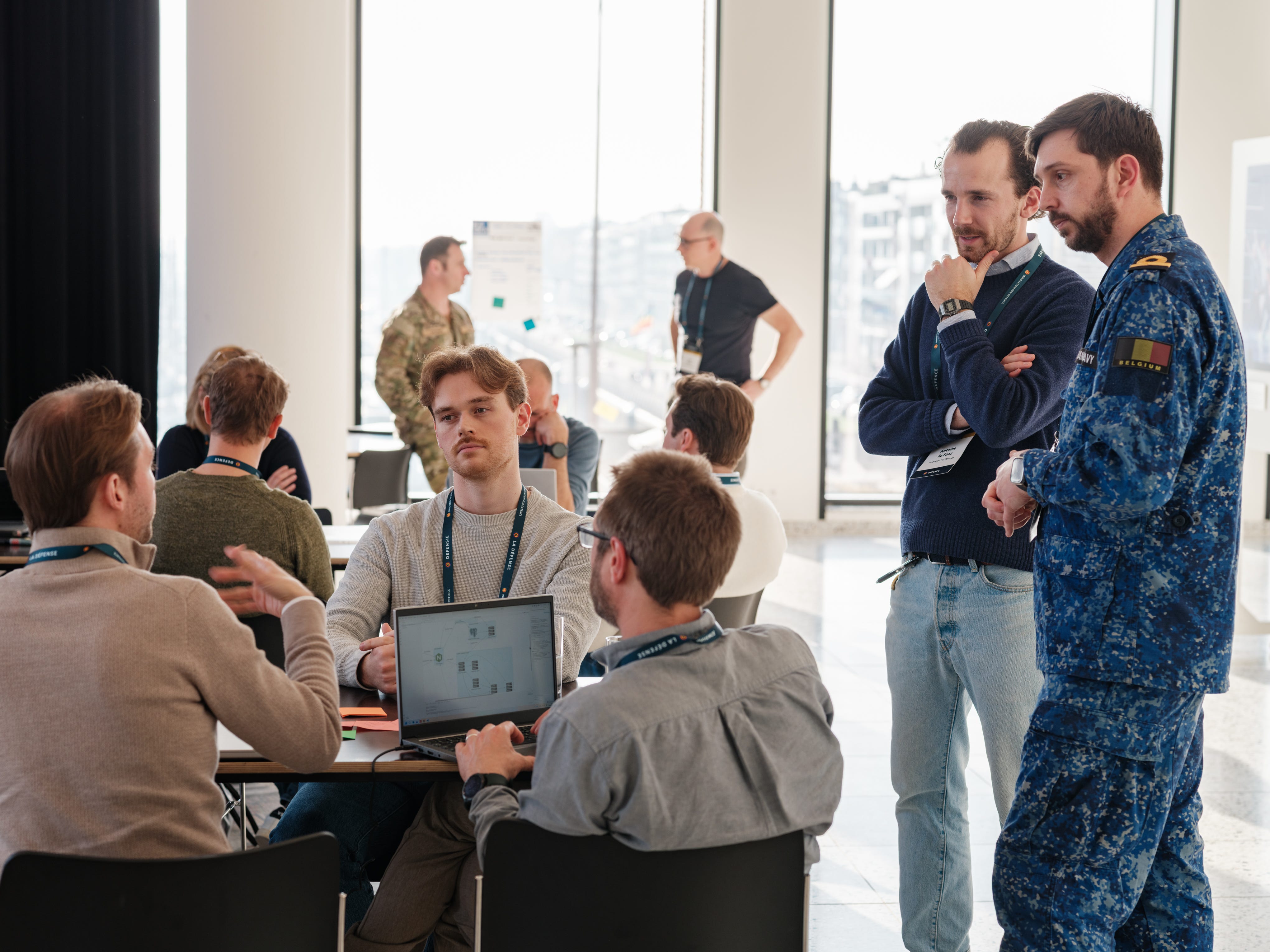
Defence tech hackathons are springing up all over Europe, sometimes with the armed forces in attendance. There was one in Tallinn two weeks ago, another in Rzeszów last weekend, and one in Brussels starting tomorrow. Earlier this week, the Belgian navy sponsored a hackathon in the port of Zeebrugge for the second year – this time overlooking a captured Russian shadow fleet tanker.
“Hackathons are a very useful way of getting people to work together,” said Leo Exter from Hack Belgium Labs, the organiser of the Zeebrugge event. “Working towards a pragmatic result, limited in scope and under time pressure, has the capacity to get people into teamwork mode very quickly and very efficiently.”
It was not an occasion for startups to pitch their products, since the focus was on coming up with entirely new ideas. Most of the participants were employees of larger companies, contributing in a personal capacity; some were in uniform. The only prize on offer was a day at sea with the navy.
Outside the box
It’s rare to see uniforms and scruffy sneakers in the same room, but the naval brass was well aware of the problems with slow military procurement and how the tech sector could help.
“We cannot rely on systems from yesterday,” said Admiral Tanguy Botman, the head of the navy. “We need people who dare to think differently, outside our military box.”
Participants were thrown into teams and quickly started brainstorming broad problems such as how to make military procurement processes more accessible, or translating operational needs into technical requirements. The overall mission was to improve maritime security, both for a wartime scenario and for the hybrid warfare that is already taking place.
“Naval is the domain most vulnerable to grey zone attacks,” said Yves Van Seters from the Antwerp Maritime Academy, who was facilitating the event. Civilian ships, energy infrastructure such as wind farms, communication cables, and ports are all vulnerable to attack or disruption, he noted.
Ideas ranged from specific technical innovations, such as a shared sensor cloud between the navy and merchant shipping, to more abstract ideas around streamlining the military tendering process or creating a ‘speed-dating’ platform to match procurement needs with civilian innovations.
There are no bad ideas, Exter said. The process is intended to bring together people with a range of backgrounds, encourage them to think creatively, and find solutions that may even go beyond the scope of the original problem.
The military may not adopt new ideas as quickly as a hackathon can conceive them but the process does make a difference, said Cdr. Michel Eyckmans, an Innovation Officer representing the navy at the event. Last year’s winning idea, a pop-up navy recruitment centre in a mobile shipping container, is currently undergoing a feasibility study. “There’s a good chance it will be built,” Eyckmans said.
In the news
A factory in Spain owned by Czechoslovak Group (CSG), has been suspended indefinitely from bidding for NATO contracts as part of a corruption investigation into the NATO Support and Procurement Agency (NSPA) begun last year, El País reported.
The US on Thursday lifted sanctions on Russian oil in an attempt to keep a lid on global prices, which soared above $100 a barrel on Monday due to the market disruption caused by the US attack on Iran. Brent crude has since stayed around the $100 level.
Dozens of Ukrainian instructors will train German soldiers in disciplines including gunnery, engineering and drone warfare, Reuters reported citing an interview with German army chief Lt. Gen. Christian Freuding.
The European Parliament this week called for a more integrated single market for defence through increased and longer-term EU funding for defence projects, common procurement, simplified regulations, and incentives for cross-border projects within the EU.
Leonardo’s UK subsidiary has agreed to buy Becrypt, which builds secure operating systems, mobile device management, and data transfer applications. It expects regulatory approvals to be completed within Q2 2026.
Further reading
European governments must make a concerted effort to win public support for increased defence spending, which will require tax rises or spending cuts elsewhere, Armida van Rij wrote for the Centre for European Reform. Defence procurement must also “get its house in order” and spend public money more efficiently, she wrote.
France’s extended nuclear deterrence is a good “stopgap” but falls short of matching the US nuclear umbrella, and may also come under pressure if populists take power in France, Wannes Verstraete wrote for the Egmont Institute.
Ukraine may benefit from the Iran war in the longer term through demand for its cheap interceptors and the strategic leverage this can provide, Olena Prokopenko wrote for the German Marshall Fund.
Europe’s rearmament spending is unevenly distributed, with countries closest to Russia generally increasing their spending by the most, Thomas Laffitte wrote for the Brussels Institute for Geopolitics.
Thank you for reading The Sentinel. To receive all of our free news and analysis, subscribe by clicking the button below.
If you’d like to submit an op-ed, or are interested in a full subscription when they become available, please email sam@the-sentinel.eu.