
The Sentinel Weekly: Europe wakes up
Plus FCAS crisis talks, another tanker strike, the risks of appeasement and more

The act of waking up is rarely immediate. The first alarm bell may pass entirely unnoticed, particularly if your slumber was long and comfortable. Later ones might register but still fail to rouse you. Eventually, though, if the alarm persists you will get up and face the day.
The closing weeks of 2025 might be remembered as the moment Europe finally awoke from the fantasy of limitless American benevolence and began to take meaningful steps towards strategic independence. The final alarm bell, too shrill to ignore, was the publication late last week of the Trump administration’s National Security Strategy.
The signs of strategic divergence have been visible for decades. Veteran defence reporter Mark Urban points to lukewarm American commitment to NATO as far back as 2011. Politically, though, the project of developing an independent military capability was too radical for European leaders to contemplate. Even in recent months, as President Donald Trump blew hot and cold on Ukraine, Europe’s establishment has grasped at every bit of good news and ignored the flashing red lights.
But with the publication of the NSS, the Trump administration “made it all but impossible for European leaders to keep fantasizing about the USA riding to the rescue”, strategic studies professor Phillips O’Brien wrote this week.
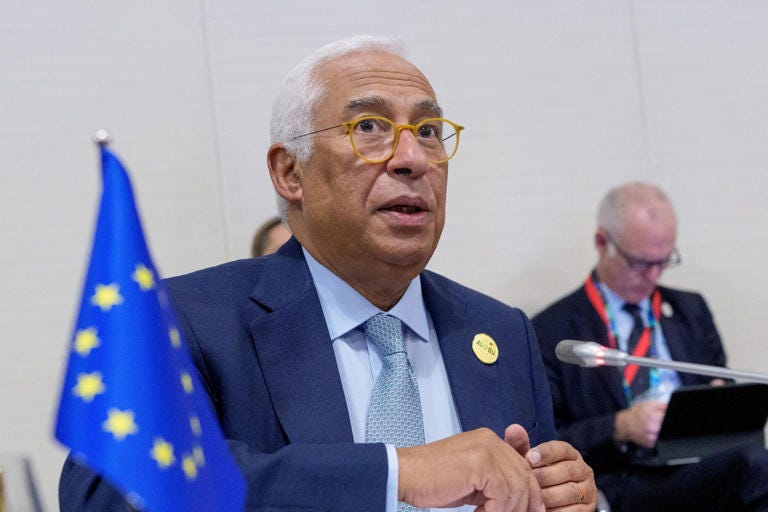
Sure enough, senior Europeans have begun to acknowledge the threat. António Costa, who chairs the EU Council of national leaders, said this week that European countries must be ready to take over leadership of NATO by 2027 and must be prepared to “protect ourselves, not only against our adversaries, but also against the allies who defy us”.
EU Defence Commissioner Andrius Kubilius, from staunchly Atlanticist Lithuania, wrote in a personal blog post that the NSS suggested that “Americans are planning to fight against the European Union”. And the military intelligence service of Denmark, whose territory of Greenland Trump covets, this week publicly stated that the US “no longer rules out the use of military force, even against allies”.
While some Atlanticist institutions have sought to downplay the divisions – the German Marshall Fund of the United States called the NSS a “new foundation for cooperation” and an act of “tough love for Europe” – mainstream European opinion is starting to see the US not only as an unreliable ally, but even as a potential threat.
Gunboat diplomacy
The real incitement for European leaders seems to have been the document’s stated intention to meddle in domestic policy: to “help Europe correct its current trajectory” through measures including “cultivating resistance to Europe’s current trajectory within European nations” and “opening European markets to U.S. goods and services”.
“What we cannot accept is this threat of interference in Europe’s political life,” Costa said in response.
Genuine challenges for Europe are exaggerated in the NSS beyond recognition. EU regulatory overreach is said to “undermine political liberty and sovereignty”; the failure to culturally integrate some migrants means that “within a few decades at the latest, certain NATO members will become majority non-European”. In supporting Ukraine, governments “trample on basic principles of democracy to suppress opposition”.
The document also contains a call to “negotiate an expeditious cessation of hostilities in Ukraine” and to “mitigate the risk of conflict between Russia and European states”, without any suggestion of applying pressure on Russia to abandon its maximalist claims, let alone hold it accountable for its aggression.
Minna Ålander, an associate fellow at Chatham House, said the NSS was a “useful document” for Europe, since it “codifies in policy, in black and white, what has been evident all year long: Trump and his people are openly hostile to Europe”.
Divide and dominate
Kubilius, in his blog post, identifies a possible motivation behind what he calls the US “fight against European unity”. He cites a 2021 book by Elbridge Colby, now Trump’s top defence policy official, that explicitly identifies the EU as an “aspiring hegemon” in Europe and thus a threat to US power.
“The United States is therefore better off if Europe is not a highly unified superstate for the same reasons that it should oppose establishment of a cohesive hegemony over any key region of the world,” Colby wrote, per Kubilius. The EU, if left alone, risks becoming “capable of establishing regional hegemony and unduly burdening or even excluding US trade and engagement.”
The US defence industry has done particularly well from European fragmentation, benefiting from America’s pre-eminence within NATO to become the continent’s indispensable supplier. When Trump pushed earlier this year for European allies to double their defence spending, he might have imagined all that extra money flowing into the US industrial economy.
Instead, his pressure tactics have led to a realisation in Europe that having an independent defence capability means exactly that. Relying on a foreign supplier that can switch off your fighter jets is only acceptable if that country’s friendship is steadfast and unconditional.
The NSS calls for Europe “to regain its civilizational self-confidence”. It may get its wish.
In the news
The defence ministers of Germany and France met yesterday, and will meet again today with their Spanish counterpart, to try to break the deadlock around the troubled FCAS joint fighter jet project.
Saab and Airbus are discussing potential cooperation on unmanned warplanes, Reuters reported.
The US has rejected a German request to integrate its stock of US-made GMLRS rockets into its new multiple-launch rocket platform, Euractiv reported. The new Euro-PULS launchers, made by Elbit and KNDS, are a backfill for MARS II systems that Germany has sent to Ukraine.
Ukrainian naval drones struck another Russian oil tanker in the Black Sea on Wednesday. The attacks on sanctioned commercial shipping, covered by The Sentinel last week, have begun to curtail Russian oil exports.
Lithuania declared a state of emergency on Tuesday due to large numbers of balloons crossing into its airspace from Belarus. The balloons, used for smuggling, have also disrupted air traffic at Vilnius airport several times. The state of emergency could authorise the armed forces to engage them.
France is shielding its private banks holding up to €18 billion in frozen Russian assets, the FT reported, even as it and other EU countries pressure Belgium to free up the €185 billion held at Euroclear to back loans for Ukraine. The UK also holds frozen Russian assets valued at about £25 billion (€29 billion).
Bangladesh has signed a preliminary agreement with Leonardo to buy up to 16 Eurofighter Typhoon fighter jets.
Germany’s parliament is planning to approve a bumper €52 billion military procurement package next week, Bloomberg reported. The order includes €4.2 billion for 200 additional Puma infantry fighting vehicles, built by KNDS and Rheinmetall.
Further reading
A bad peace deal imposed on Ukraine would embolden Russia to attack other countries in Europe and ultimately cause NATO to unravel, Roland Freudenstein wrote in an op-ed for The Sentinel.
European countries may have to shoot down Russian planes if airspace violations continue, Czech President Petr Pavel told The Times – drawing on his own country’s history to warn against appeasing an aggressor. “We simply cannot let Ukraine lose this conflict,” the former general said.
America’s domination of Europe is economic and cultural as well as military, according to Brussels-based journalist Dave Keating. In a new book available for pre-order, he assesses the scale of Europe’s dependency and proposes a way out of it.
We’ve changed the format of this section following the publication this week of our first guest op-ed. This new format allows us to feature more points of view from our own pages and beyond.
Thank you for reading The Sentinel. To receive all of our free news and analysis, subscribe by clicking the button below.
If you’d like to submit an op-ed, or are interested in a full subscription when they become available, please email sam@the-sentinel.eu.