
The Sentinel Weekly: Canada walks the talk
Its defence ties with Europe are keeping Atlanticism alive

At the start of this year, Mark Carney set out in admirably clear terms how the global order has changed, and how middle powers – a group that includes European countries – can survive and prosper in this new paradigm.
A few months later, the Canadian prime minister is backing up his statement that “middle powers must act together” with a series of defence sector deals with Europe. In so doing, he has ensured that some form of Atlanticism will persist regardless of how the US acts.
European leaders are delighted to keep Canada in the club. ‘European NATO’ is the trendy phrase of the moment but when asked to spell it out, EU officials make clear that Canada is included. Evidently the more accurate term, ‘NATO without America’, was considered insufficiently diplomatic.
Canada joined the EU’s Security Action For Europe (SAFE) funding mechanism last year, securing access to joint purchasing projects and integrating its defence sector more closely with those in Europe. Regardless of geography, Canada is now more closely aligned in defence matters – from procurement to its support for Ukraine – with the EU than with its southern neighbour.
That policy came to fruition this week with Canada’s announced purchase of Saab’s GlobalEye Airborne Early Warning & Control (AEW&C) system. Besides reducing its dependence on the US, which makes the only other such system on the global market, Canada secured thousands of local manufacturing jobs and demand for the Canadian Bombardier aircraft on which the system is based.
Diplomatic offensive
The headline deals at this week’s CANSEC trade fair have been accompanied by busy diplomacy, with Ottawa playing host to senior delegations from Poland, Germany and the EU.
Poland’s defence minister Władysław Kosiniak-Kamysz was in Canada this week and signed a letter of intent with his Canadian counterpart David McGuinty to deepen bilateral cooperation, the first of its kind between the two nations. The deal involves a Canadian purchase of Polish drones, as well as joint exercises between their respective armed forces.
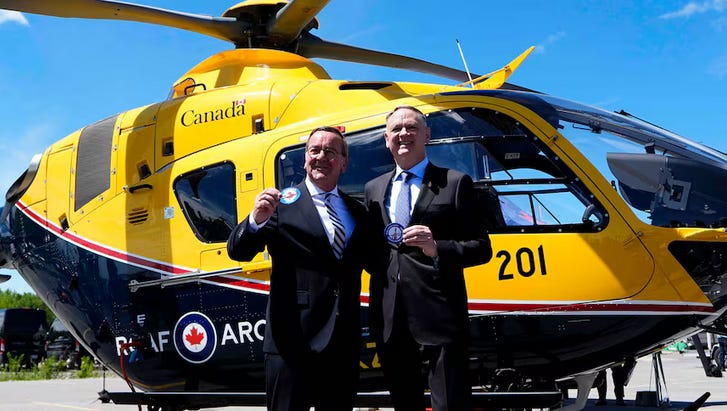
German defence minister Boris Pistorius was also in Ottawa this week, pitching a sale of submarines made by ThyssenKrupp Marine Systems in a deal that would include German assistance on a range of civilian engineering projects.
In unusually direct language for a German politician, Pistorius appeared to describe the US as a threat, as he made a pitch for closer cooperation with Canada. “Sitting in front of the White House or any other building in the world like the rabbit in front of the snake would not make us stronger. It makes us weaker,” news agency DPA quoted him as saying.
The senior Europeans who descended on Ottawa this week showed that Atlanticism isn’t dead, it’s just got a new centre of gravity. And Carney’s vision of a brotherly band of middle powers is one step closer to reality.
In the news
Sweden will transfer 16 used Saab Gripen fighter jets to Ukraine, beginning next year, pending an anticipated order for up to 150 units in the coming years.
NATO will assign the German-Netherlands Corps to the defence of Estonia and Latvia, Reuters reported, joining the Multinational Corps Northeast, based in Poland, in defending NATO’s eastern flank.
Indra’s board of directors has appointed Renault executive Josep Maria Recasens as CEO. He will replace José Vicente de los Mozos in mid-June.
Only 9 countries are still participating in a Czech-led coalition to send artillery ammunition to Ukraine, down from 18 at its peak last year, the Financial Times reported citing an interview with President Petr Pavel
Lithuania will purchase 936 armoured vehicles from Finland’s Patria in a €1.5 billion deal as it builds out its First Division, set to become operational by 2030 with a strength of 20,000 soldiers.
Further reading
The US military drawdown has exposed Europe’s lack of long-range strike capabilities at ranges greater than 500km, an essential pillar of conventional deterrence against Russia, Luigi Scazzieri wrote for the EU’s Institute for Security Studies.
Poland, arguably Europe’s most Atlanticist country, is beginning to turn away from the US and deepen its partnerships with its neighbours as a result of the Trump administration’s policies, Philip Bednarczyk wrote for the German Marshall Fund.
The Sentinel is a few weeks away from launch, when we will move on to our own platform and greatly expand our output. If you’re subscriber here, you’ll receive a weekly editor’s letter and will have access to a limited amount of content in front of our paywall.
If you’d like to submit an op-ed to be published after launch, or are interested in a full subscription when they become available, please email sam@thesentinel.eu.