
The Sentinel Weekly: Beyond the new thing
Legacy systems won’t all be replaced by drones

A €500 million procurement decision by a European country bordering Russia gives a good sense of how the industry might evolve in the coming years.
But this is not a story about Estonia’s decision to redirect half a billion euros from infantry fighting vehicles (IFVs) to drones. What’s arguably more interesting is Finland’s decision to spend the same amount of money to double its stock of self-propelled artillery.
The parallel decisions, both by countries preparing seriously for a high-intensity war, show that the shift to drones is real but is not the whole picture. Estonia will upgrade its existing IFVs rather than replacing them. And the Finns are doubling down on a technology that evolved alongside the battle tank and defined Cold War land doctrine.
Drones are the new, shiny thing; in the past five years they have gone from being a niche system to a core pillar of combined arms warfare. It’s rational that money is pouring in as armies rush to build up their capabilities from zero. Once that’s done, however, attention will shift back to legacy systems that are still relevant, and that will need to be produced in much greater numbers to sustain a full-scale war effort.
Drones in demand
Late last week, Estonia’s defence minister said the country was cancelling a €500 million procurement program for new armoured vehicles and instead directing the budget to air defence and drones. “We are keeping up with what we are learning from Ukraine,” Hanno Pevkur said according to news site ERR. “The focus is on countering drones, air defence and unmanned systems.”
Across the continent, drone procurement is in the headlines. Last month the Dutch forces said drone and counter-drone units would be integrated into every formation. British commandos this week demonstrated how cargo drones could improve the mobility of heavy weapons teams in difficult terrain. Everyone wants long-range strike drones, and cheap interceptors to counter them.
Note how drones in most cases are augmenting existing capabilities, not replacing them. Similarly, Estonia is not removing armoured vehicles from its order of battle; it’s merely delaying upgrades to spend its budget on a more pressing need. Nobody is going all-in on drones.
Talk of the end of legacy systems is most likely overstated. From fiat currency to email, tech bros have a track record of wrongly declaring the end of things. More often, they continue to exist alongside their supposed replacements.
The obituary of the battle tank has been written before, after the introduction of attack helicopters and anti-tank guided missiles. And yet new defensive systems and tactics evolved to keep it relevant. As it turns out, a big gun on a protected mobile platform is a useful tool in many scenarios.
SPARTY time
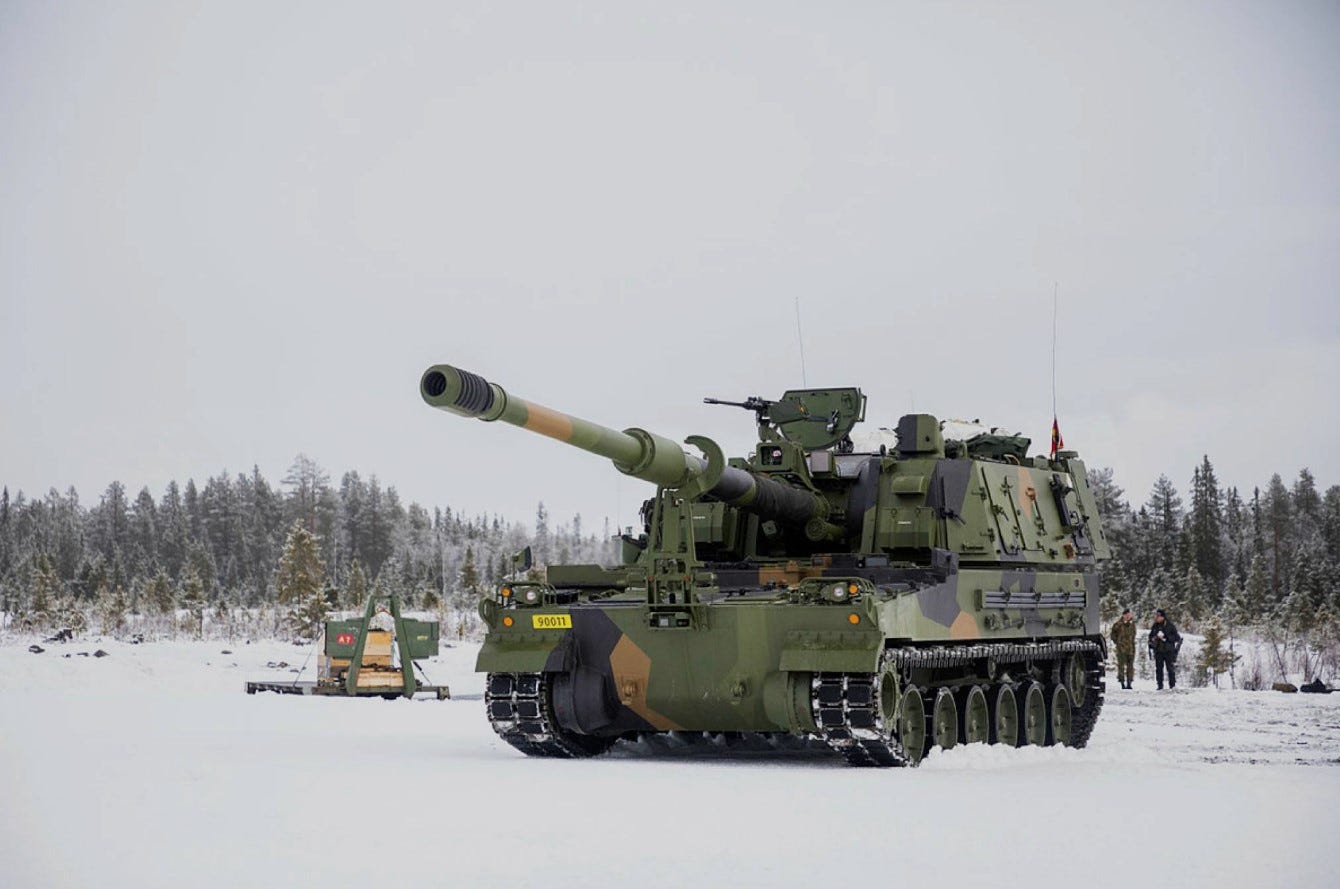
Similarly, Finland appears to have calculated that self-propelled artillery (SPARTY for fans of military acronyms) will continue to be useful in the coming decades. A day after the Estonian drone news, the Finnish defence ministry announced the purchase of an additional 112 K9 howitzers from Korea for almost €550 million, more than doubling its stock.
Self-propelled guns were first used at scale in the Second World War, providing heavy fire support to mechanised formations. During the Cold War, advances in counter-battery fire, whereby an enemy could detect the source of incoming shells and shoot back with their own artillery, led in turn to ‘shoot and scoot’ tactics to reposition guns after each salvo. This reduced the usefulness of towed guns, which are slow to redeploy.
Modern self-propelled howitzers like the K9 can fire NATO standard 155mm shells up to 40km, well beyond visual targeting and at the limit of FPV drones’ operational range. Combined with mobility and decent armour, this makes them hard to kill so long as the airspace is at least contested.
This appears to have factored into Finland’s decision. The defence ministry noted the K9’s “good off-road and road mobility” and said the new purchase would “partially replace aging towed artillery equipment”.
A few weeks ago, Rheinmetall CEO Armin Papperger drew unfavourable media coverage for his disparaging comments about the limitations of Ukrainian drones. “This is not the technology of Lockheed Martin, General Dynamics, or Rheinmetall,” he said, provoking particular criticism for an ill-considered reference to “Ukrainian housewives” assembling drones at the kitchen table.
But while his tone was objectionable, Papperger’s message had a ring of truth to it. Once the novelty of drones fades, modern armies will still be buying tanks, planes and guns. And, if war comes, lots and lots of ammunition.
In the news
Rheinmetall has agreed to form a joint venture with Destinus to scale production of strike missiles, the two companies announced. The new company will be 51% owned by Rheinmetall and based in Germany.
Small arms maker Colt CZ has joined fellow Czech company CSG in listing on Euronext Amsterdam, alongside its existing listing on the Prague Stock Exchange, it said in a statement.
The European Commission is planning new guidelines on merger control that would relax restrictions and encourage the creation of “European champions” to rival giant US and Chinese firms, the Financial Times reported citing a draft it had seen.
French helicopter gunships have shot down Iranian Shahed drones in the Gulf using their 30mm nose cannon, Defense News reported, in a display of relatively low-cost interception capability.
Germany has pledged to spend an additional €4 billion on assistance for Ukraine, buying a mix of US and German equipment with a focus on air defence and long-range strike capabilities, the Kyiv Post reported.
Belgium and Spain will each donate €1 billion in military equipment to Ukraine, Defence Minister Mikhail Fedorov said after talks with his counterparts Theo Franken and Margarita Robles, DS News reported.
Further reading
The European Defence Agency’s annual report reveals new mandates for structured cooperation between member states, and ambitions in loitering munitions, ground drones and air defence.
The EU and NATO are in a “turf war” over Europe’s rearmament, with both trying to take on new capabilities in defence industrial policy, Henry Foy wrote for the Financial Times.
Thank you for reading The Sentinel. To receive all of our free news and analysis, subscribe by clicking the button below.
If you’d like to submit an op-ed, or are interested in a full subscription when they become available, please email sam@thesentinel.eu.